Hook Examples

UGC ScriptsBy Indian UGC Team10 min read

UGC Hooks Examples for Indian D2C Ads

The best UGC hooks make the buyer stop because they name one hesitation fast: confusion, doubt, price, effort, trust, or comparison. Indian D2C brands should start with one product action, one local buyer situation, and one short spoken line, then test hooks without changing the whole video at once.

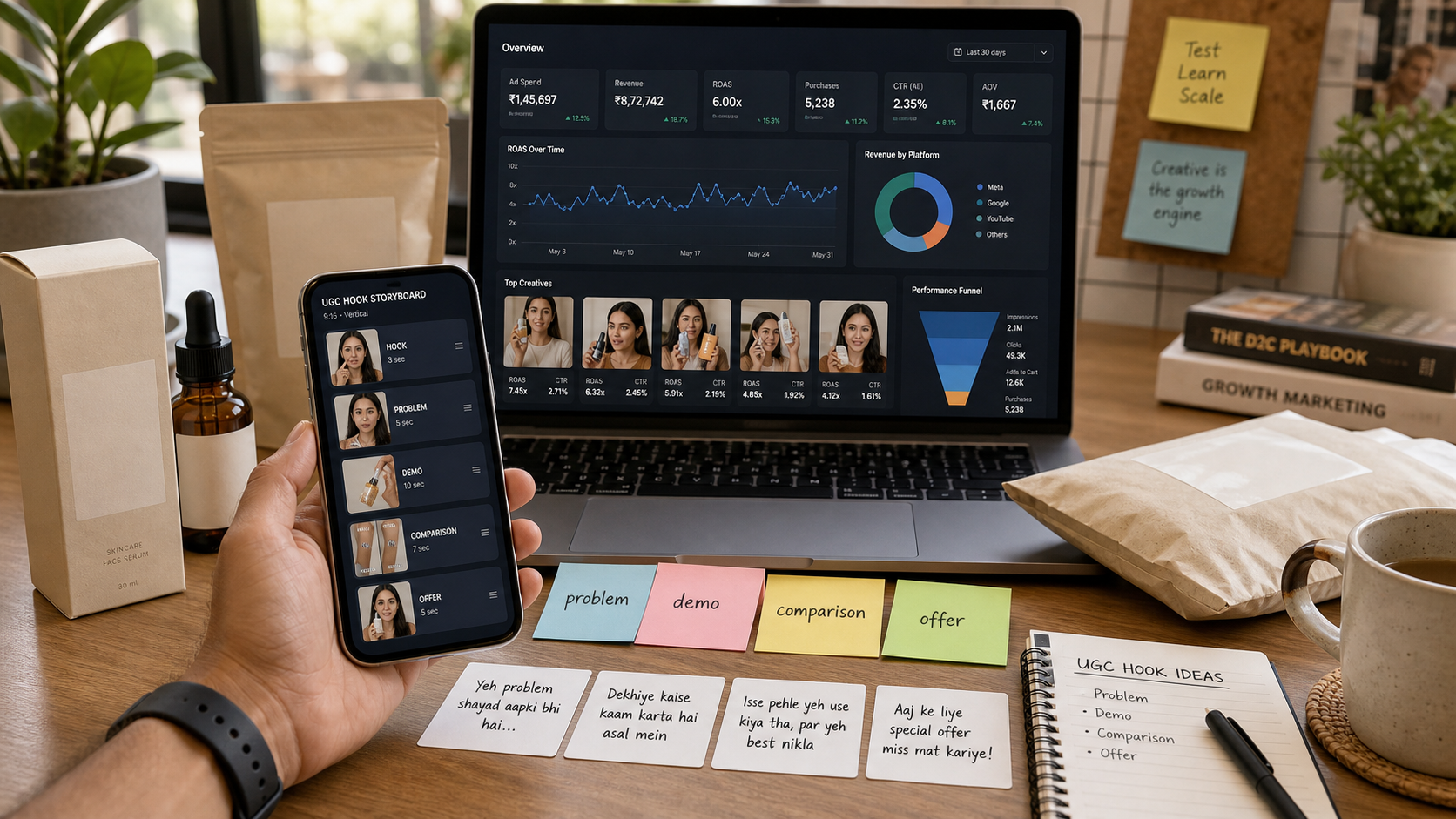
Indian D2C marketing desk with UGC hook examples, creator video storyboards, and ad testing notes

What are UGC hooks?

UGC hooks are the first spoken line, visual moment, or on-screen idea that makes someone stop watching a creator-style ad. A useful hook does not sound like a brand slogan. It sounds like a buyer problem, a product discovery, a comparison, a mistake, or a practical reason to keep watching the product demo.

Start from the broader examples guide if you need full ad structures: /blog/ugc-ads-examples-india

Use script examples when the hook needs a full 15 to 30 second video: /blog/ugc-video-script-examples-india

Turn the winning hook into a generator prompt with /blog/ugc-video-generator-prompts-india

Generate the first AI UGC draft in /dashboard/ugc-video

Which UGC hook should an Indian D2C brand test first?

Test the hook that removes the buyer's biggest reason for not clicking. If the product is hard to understand, start with a problem-demo hook. If the category is crowded, start with a comparison hook. If price is the objection, start with value-per-use or routine-fit language before testing a discount hook.

New category: 'I did not get why this product existed until I used it for this one thing'

Crowded category: 'Most products in this category miss this tiny detail'

Price objection: 'This looks expensive until you break it into daily use'

Effort objection: 'I wanted something that did not add another step to my routine'

Trust objection: 'I would not buy this from a fancy claim; I would check this first'

Plan the test without changing every variable at once: /blog/ad-creative-testing-india

How do you turn UGC hook examples into AI video prompts?

Turn a UGC hook into an AI video prompt by writing one creator persona, one Indian setting, one product action, one spoken hook, and one CTA. Do not ask the AI to invent a full ad from a vague hook. The more concrete the first action is, the easier the output is to review.

Prompt part 1: creator persona, such as young parent, skincare buyer, office commuter, college student, homemaker, or fitness buyer

Prompt part 2: setting, such as Indian kitchen, vanity mirror, office desk, balcony, commute prep, or bedroom shelf

Prompt part 3: action, such as open, apply, taste, wear, compare, assemble, clean, pack, or show a before-and-after setup

Prompt part 4: short spoken hook, preferably one line a real creator could say naturally

Source note: Meta video ad format guidance recommends mobile-ready video creative, facebook.com/business/ads/video-ad-format

Source note: Google's video ABCDs framework emphasizes attention, branding, connection, and direction, support.google.com/google-ads/answer/14783551

Why do UGC hooks fail?

UGC hooks fail when they are clever but not useful. A hook may sound catchy, but if it hides the product, targets the wrong hesitation, copies a competitor, overpromises the result, or uses language the buyer would never say, the viewer does not get a reason to keep watching.

Bad: 'You need this viral product' with no product action

Better: 'I bought this because my 4 pm snack habit was getting expensive' with the product visible immediately

Bad: translated English hook forced into formal Hindi

Better: natural Hindi, Hinglish, Tamil, or regional line after the same product action is proven

Use the regional-language guide before scaling language variants: /blog/regional-language-ugc-ads-india

Create static retargeting variants in /dashboard/static-ads when the hook is clear but the offer needs a visual follow-up

When should you use Hindi, Hinglish, or regional UGC hooks?

Use the language your buyer already uses around the category. Hinglish often works for metro D2C products because buyers naturally mix English product words with Hindi phrasing. Hindi-first or regional hooks work better when household trust, state demand, food habits, beauty routines, family use, or local identity matter.

Use Hinglish when the product words are already English: serum, protein, snack, organizer, app, shampoo, fit, pack, routine

Use Hindi-first when the buyer needs comfort, trust, or family-context explanation

Use Tamil, Telugu, Marathi, Bengali, Kannada, Malayalam, or Gujarati when order, traffic, comment, or media data proves state-specific demand

For Hindi and Hinglish scripts, use /blog/hindi-ugc-ads-ecommerce-india

For Tamil variants, use /blog/tamil-ugc-ads-india

UGC hook decision table

Buyer hesitation
Hook example
AI prompt direction
They do not understand the product
I did not get this until I used it for one small thing
Creator shows one use case in the first seconds
They doubt the result
I would not believe the claim; I would check this part first
Creator points to texture, fit, taste, routine, or setup proof without exaggeration
They compare alternatives
Most options solve this part but ignore this other problem
Creator compares one category tradeoff while holding the product
They think it is expensive
This made sense when I looked at cost per use
Creator connects price to repeat use, bundle value, or avoided waste
They think it is hard to use
I wanted the easiest version of this routine
Creator opens, applies, assembles, tastes, wears, or cleans in one simple scene
They need trust
I would send this to a friend who has the same problem
Creator speaks like a recommendation, not a scripted testimonial

Best For

Indian D2C brands planning weekly UGC creative tests

Performance marketers trying to improve the first three seconds of Meta or Instagram ads

Agencies turning product briefs into AI UGC video prompts

Brands testing Hindi, Hinglish, English, or regional-language hooks

Not Ideal For

Copying competitor ads word for word

Guaranteeing performance from one hook without a testing plan

Medical, financial, or legal claims without compliance review

Imitating a known creator, celebrity, voice, or influencer style

Examples

Beauty: 'If your skincare pills after sunscreen, check this texture first.' Vanity mirror, product applied once, claim-safe routine cue.
Snack: 'If your chai break always becomes expensive, this is the pack I would keep nearby.' Kitchen counter, first bite, simple offer cue.
Fashion: 'I wanted one kurta that did not need styling drama.' Mirror try-on, fabric detail, office-to-dinner use case.
Home organizer: 'This drawer was the one I kept avoiding.' Messy drawer, product-led fix, clean reveal.
Wellness: 'I wanted a morning routine that did not feel like homework.' Breakfast table, product prep, conservative routine line.
Pet care: 'My dog ignored the fancy thing and used this first.' Living-room demo, close product shot, owner reaction.
Hindi or Hinglish: 'Bas ek cheez chahiye thi jo daily routine ko easy bana de.' Same product action, shorter spoken line.
Retargeting: 'I saw this three times before I checked what it actually does.' Product appears immediately, CTA stays direct.

FAQs

What is a good UGC hook?

A good UGC hook names one buyer hesitation and shows the product quickly. It can be a problem, mistake, comparison, price objection, routine moment, or friend-style recommendation, but it should feel like spoken creator language instead of a brand slogan.

How do I write UGC hooks for Indian ads?

Start with one Indian buyer situation, one product action, and one language choice. Write the line in natural English, Hinglish, Hindi, or a regional language, then remove formal brand copy and keep the product visible from the first seconds.

Can AI generate videos from UGC hooks?

Yes. AI can turn UGC hooks into creator-style video drafts when the prompt includes one creator persona, one setting, one visible product action, one spoken hook, and one CTA. Review outputs for product accuracy, claim safety, and cultural fit before using them in ads.

Why are my UGC hooks not working?

They may be too generic, too slow, too clever, or disconnected from the buyer's real objection. Fix the hook by choosing one hesitation, showing the product earlier, and testing only one creative variable at a time.

Should UGC hooks be in Hindi or English?

Use the language the buyer already uses around the product. English or Hinglish often works for metro D2C audiences, while Hindi-first or regional hooks can work better for household trust, food, beauty, wellness, and state-specific demand.

Can AI UGC replace real creators?

AI UGC is best for fast creative testing, early campaign drafts, hook exploration, and low-cost content volume. Real creators still matter for influencer distribution, creator trust, and testimonial rights.

Does AI UGC work for Indian audiences?

It can work well when the prompt includes Indian personas, local language, realistic home settings, product-in-hand moments, and duration-safe dialogue instead of generic global stock-style scenes.

What assets do I need to start?

A product name, a short product brief, and ideally one clean product image are enough to generate the first AI UGC video or product visual.