Creative Brief

D2C Ad CreativesBy Indian UGC Team11 min read

Ad Creative Brief Template for Indian D2C Brands

An ad creative brief should tell the creator, designer, or AI system exactly what the ad must prove. For Indian D2C brands, the fastest brief includes one buyer hesitation, one product action, one hook, one setting, one offer or proof cue, one CTA, and a review checklist before any UGC video or static ad is generated.

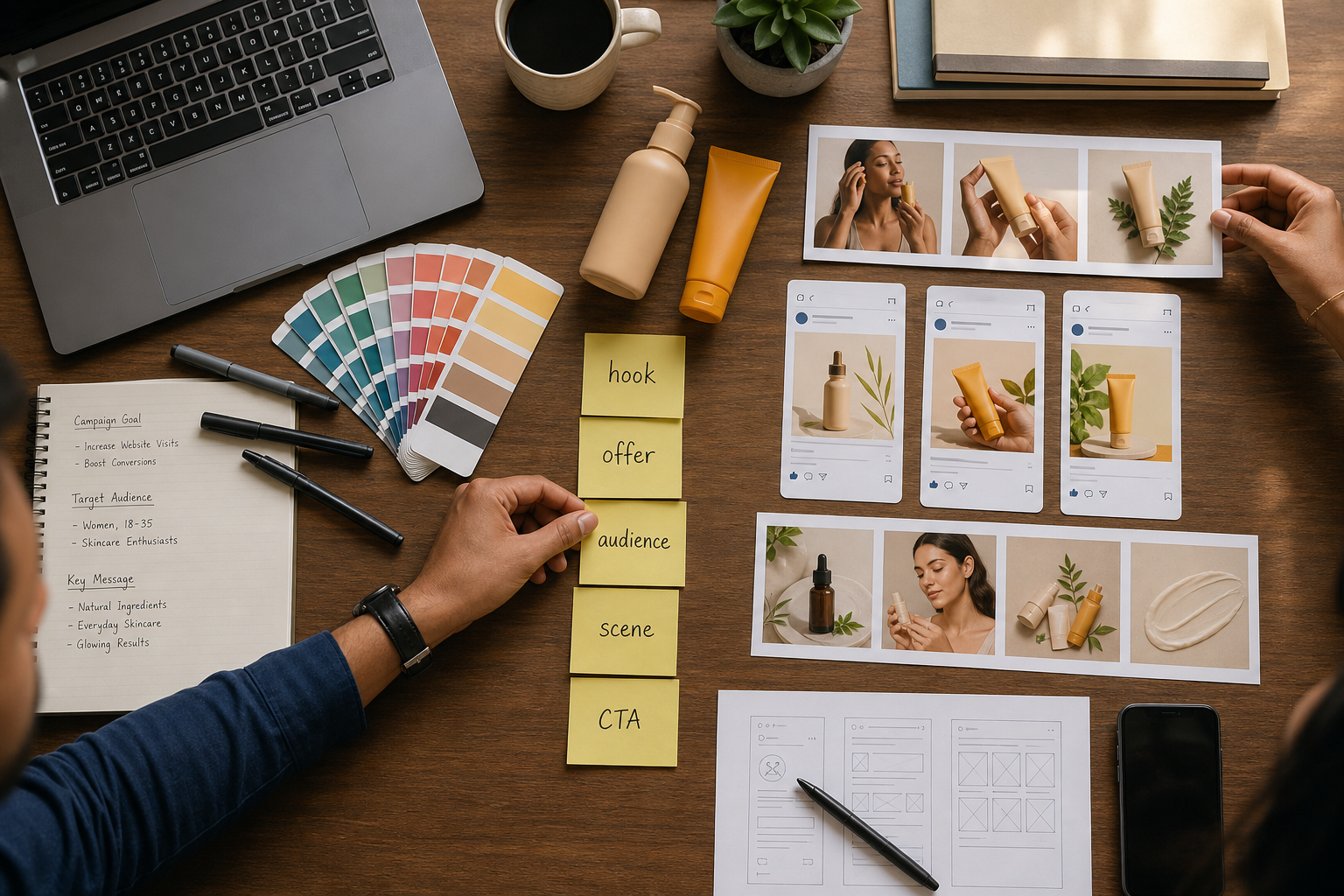
Indian D2C ad creative brief workspace with product packshots, hook notes, storyboard cards, and mobile ad layouts

What is an ad creative brief?

An ad creative brief is a short production document that turns a campaign goal into a specific ad asset. It defines the buyer, hesitation, hook, product action, format, setting, offer, proof cue, CTA, and review rules so the final creative solves one job instead of becoming a vague brand video.

Ad creative brief is the source document that tells a creator, designer, editor, or AI generator what the ad must show, say, avoid, and make the viewer do.

Use /blog/d2c-ad-creative-examples-india when the team still needs format ideas before writing the brief.

Use /blog/product-demo-ad-creatives-india when the brief depends on one clear product action.

Use /dashboard/ugc-video when the brief is ready for an AI UGC video draft.

What should a D2C ad creative brief include?

A D2C ad creative brief should include only the decisions that change the output: buyer segment, buying hesitation, product action, first-frame hook, setting, format, offer, proof cue, CTA, language, claim guardrails, and success metric. If it cannot change the creative, leave it out of the first brief.

Audience: who is watching, what they already know, and why they hesitate.

Hook: the first line or visual moment that makes the ad worth watching.

Product action: the one thing the viewer must see the product do.

Scene: Indian kitchen, vanity, work desk, wardrobe, commute prep, gifting table, or product flat lay.

Offer and CTA: where the ad sends the viewer and why they should act now.

Review rules: product accuracy, mobile crop, claim safety, language fit, and no unreadable generated text.

How do you write an ad creative brief for AI UGC?

Write an AI UGC brief as a compact prompt plus review checklist. Name the creator role, Indian setting, product, visible action, spoken line, CTA, duration, and things to avoid. Keep the first version to one scene because multi-scene prompts usually produce weaker product clarity.

Prompt formula: buyer hesitation plus creator persona plus setting plus product action plus spoken hook plus CTA plus guardrails.

Good: young Indian office commuter opens the snack pack during chai break, product visible, says one convenience line, vertical ad, no readable fake label text.

Good: skincare buyer at bathroom mirror shows texture and routine timing, no medical claims, no before-after result promise.

Bad: make a viral UGC ad for our amazing product with lots of benefits.

For creator-persona decisions, use /blog/ai-ugc-creator-persona-india.

For prompt formulas, use /blog/ugc-video-generator-prompts-india.

What is the fastest ad creative brief template?

The fastest template is one page with nine fields: product, buyer, hesitation, hook, format, scene, product action, CTA, and review rule. Fill it in before choosing music, editing style, color, or campaign naming. Speed comes from fewer decisions, not from skipping the brief.

Product: what is being sold and what must stay visually accurate.

Buyer: the person most likely to care about this specific angle.

Hesitation: the doubt the creative must remove.

Hook: one first-frame line or visual action.

Format: UGC video, product demo, static offer card, comparison, or regional-language variant.

Review rule: the one thing that would make this ad unusable if wrong.

How do you turn one brief into video and static ad variants?

Turn one brief into variants by keeping the buyer hesitation and product action fixed while changing only the format. Make a UGC video for explanation, a static ad for retargeting, a product demo for clarity, and a regional-language version only after the base product action works.

UGC video: creator-style explanation with product visible early.

Static ad: one product visual, one offer or proof cue, one CTA.

Product demo: first-frame product action that removes confusion.

Regional variant: same scene and CTA rewritten into natural Hindi, Hinglish, Tamil, Telugu, Kannada, Malayalam, Marathi, Bengali, or Gujarati.

Use /blog/static-ad-creatives-d2c-india after the UGC video has already educated the buyer.

Use /blog/regional-language-ugc-ads-india before scaling local language variants.

Why do ad creative briefs fail?

Ad creative briefs fail when they list brand preferences but skip the buyer problem. A weak brief asks for a beautiful ad, viral UGC, or premium feel. A strong brief says what the viewer currently doubts, what they must see, what the product should not claim, and what next action the ad should drive.

Weak brief: show our product in a modern lifestyle scene.

Better brief: show a busy office buyer using the product once during a chai break to answer convenience hesitation.

Weak brief: create five very different ads.

Better brief: keep the product action and offer fixed, then test three hooks.

Source note: Meta's ad guide documents image and video placement formats across Facebook and Instagram, facebook.com/business/ads-guide.

Source note: Google's video ABCDs framework focuses on attention, branding, connection, and direction, support.google.com/google-ads/answer/14783551.

Ad creative brief decision table

Brief field
What to write
Common mistake
Buyer hesitation
The doubt blocking the click or purchase
Writing a broad audience persona without the objection
Hook
One line or visual that earns the first three seconds
Starting with logo, slogan, or vague lifestyle
Product action
One visible use, texture, fit, pour, pack, routine, or comparison
Listing five benefits with no proof moment
Scene
One Indian setting that makes the use case believable
Choosing a generic studio or foreign-looking room
CTA
The next step that matches the viewer's stage
Using a generic shop now CTA for every variant
Review rule
The failure condition to reject before launch
Approving because the ad looks polished

Best For

Indian D2C founders briefing UGC videos, static ads, and product demos

Performance marketers turning winning hypotheses into prompt-ready creative variants

Agencies that need repeatable creative briefs before creator or AI production

Teams moving from broad ad inspiration to one clear production decision

Not Ideal For

Replacing legal, platform, or claims review for regulated categories

Imitating a specific creator, influencer, competitor, or celebrity ad

Writing long brand manifestos that do not change the final creative

Approving AI-generated product visuals without checking product accuracy

Examples

Snack brand: office buyer opens the pack during chai break, mentions convenience, then CTA goes to the trial bundle.
Skincare brand: bathroom-mirror routine clip shows texture and timing, with claim-safe copy reviewed before launch.
Fashion brand: mirror try-on shows fit and occasion, then static retargeting repeats the strongest style cue.
Home utility brand: messy drawer before-state, one product action, clean reveal, and a simple offer card follow-up.
Wellness brand: breakfast-table routine scene focused on taste, habit fit, or convenience instead of medical outcomes.
Regional campaign: the same winning brief becomes a Hindi or Hinglish variant without changing product action, scene, or CTA.

FAQs

What is an ad creative brief?

An ad creative brief is a short document that defines what an ad must communicate and show. It usually includes the audience, buyer hesitation, hook, product action, format, scene, offer, CTA, and review rules.

What should be in a D2C ad creative brief?

A D2C ad creative brief should include the product, buyer, hesitation, hook, product action, setting, format, offer, CTA, language, and review checklist. The best briefs are short enough to turn into a creator brief or AI prompt.

How do I brief AI UGC video ads?

Brief AI UGC video ads with one creator role, one Indian setting, one product action, one spoken hook, one CTA, duration, and guardrails. Avoid asking for a broad viral ad. Keep the first draft to one scene so it is easier to review.

Should a creative brief include examples?

Yes, but examples should explain the ad structure, not invite copying. Include the buyer hesitation, first frame, product action, and CTA you want to borrow from the example, then rebuild it around your product.

Can one brief create both UGC video and static ads?

Yes. Keep the buyer hesitation, product action, offer, and CTA fixed, then adapt the format. Use UGC video to explain or build trust, and use static ads for retargeting, offer clarity, comparison, or reminders.

Can AI UGC replace real creators?

AI UGC is best for fast creative testing, early campaign drafts, hook exploration, and low-cost content volume. Real creators still matter for influencer distribution, creator trust, and testimonial rights.

Does AI UGC work for Indian audiences?

It can work well when the prompt includes Indian personas, local language, realistic home settings, product-in-hand moments, and duration-safe dialogue instead of generic global stock-style scenes.

What assets do I need to start?

A product name, a short product brief, and ideally one clean product image are enough to generate the first AI UGC video or product visual.