Regional-Language Ad Production

Regional-Language UGCBy IndianUGC Team10 min read

Regional-Language Subtitles for UGC Ads in India

For regional-language UGC ads, adapt subtitles from the approved message rather than translating the English transcript word for word. Keep each caption to one short idea, time it to the spoken delivery, use a fluent reviewer, protect the mobile safe area, and check the final export muted on a small phone. Test subtitle language separately from the hook, offer, and visual proof.

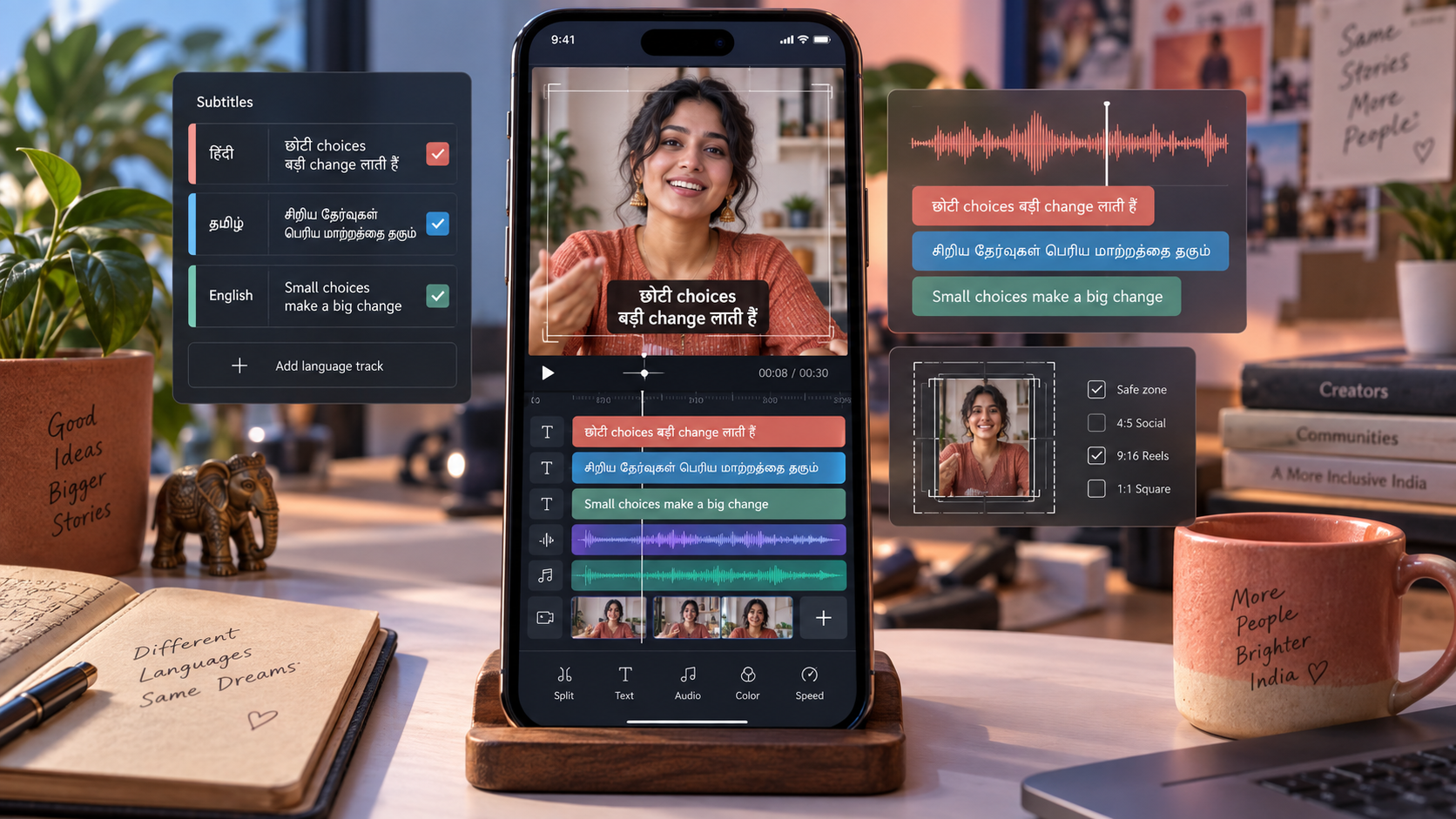
Indian UGC video editor reviewing regional-language subtitle tracks on a vertical ad

What are multilingual subtitles in a UGC ad?

Multilingual subtitles are reviewed on-screen captions that carry a UGC ad's spoken meaning in one or more audience languages. They are not a raw transcript or decorative translation. Good subtitles preserve the product claim, proof, tone, and CTA while making the video understandable without sound and natural to the intended reader.

Spoken track: the creator's natural delivery in the approved language.

Subtitle track: concise reading copy timed to that delivery.

Brand layer: approved product names, claims, prices, offers, and CTA wording.

Review layer: one fluent-language check and one separate brand-accuracy check.

Use /blog/regional-language-ugc-ads-india to decide which audience and language deserve a version first.

What is the fastest reliable subtitle workflow?

Lock the commercial meaning before opening the editor. Approve the hook, product fact, proof moment, offer, and CTA in a simple source script; adapt that script into the target language; then create subtitles from the final spoken take. This order prevents teams from captioning an outdated translation and keeps review focused.

1. Mark the non-negotiable product facts and claims in the source script.

2. Ask a fluent adapter to rewrite for natural speech, not literal sentence matching.

3. Record or generate the final voice track and freeze the selected take.

4. Break the spoken meaning into short caption units, then time each unit by ear.

5. Review language, product accuracy, mobile layout, and export quality separately.

6. Create the first regional-language video draft in /dashboard/ugc-video.

Should subtitles translate every spoken word?

No. Subtitle the meaning a viewer needs at that moment. Literal translation often produces long lines, unnatural grammar, and captions that disappear before they can be read. Keep product names and required claims exact, but compress filler, repeated phrases, and spoken hesitations when removing them does not change the promise or tone.

Preserve: product fact, buyer problem, proof, qualification, offer, and CTA.

Adapt: idiom, sentence order, formality, and English words the audience naturally keeps.

Trim: repeated openings, filler words, and verbal restarts that add no meaning.

Never simplify a limitation or disclaimer until it says something broader than the approved claim.

Use /blog/regional-language-ad-localization-checklist-india for the wider meaning, voice, and cultural review.

How should regional-language captions look on a phone?

Design captions for the smallest placement, not the editing monitor. Use a clean typeface that supports the complete script, strong contrast, generous line spacing, and a stable position away from platform controls and product proof. Two short lines are safer than a dense paragraph, especially when a script mixes Indian and Latin characters.

Keep one idea on screen at a time and prefer natural phrase breaks over equal line lengths.

Avoid splitting a product name, number, price, or negative phrase across caption cards.

Use a solid or lightly opaque backing when the footage changes brightness behind the text.

Keep captions clear of faces, packaging, demonstrations, CTA buttons, and placement UI.

Check numerals, punctuation, vowel marks, conjuncts, and mixed-script spacing in the rendered export.

Watch once muted at normal speed on a small phone before approval.

How do you subtitle Hinglish and mixed-language UGC?

Write Hinglish the way the defined audience naturally reads it, then stay consistent. Devanagari may be clearer for a Hindi-first audience, while Latin-script Hinglish can suit an audience accustomed to reading conversational Hindi that way. Do not switch scripts randomly within one ad; choose based on audience evidence and review with a fluent reader.

Keep familiar brand and feature names in their approved spelling.

Choose Devanagari or Latin-script Hindi deliberately instead of auto-transliterating every word.

Read the captions aloud to catch formal words that clash with casual creator delivery.

When the spoken line uses English naturally, a forced translated substitute can feel less authentic.

For dubbed adaptations, use /blog/ai-video-dubbing-ads-india to align voice, lip movement, captions, and proof.

What subtitle mistakes make UGC ads feel translated?

The most damaging failures are visible before performance data arrives: captions lag behind the voice, sentences sound written rather than spoken, scripts mix registers, line breaks hide meaning, or the translation changes the product promise. A structured review catches these failures faster than generating more language variants.

Word-for-word copy that is too long for the spoken beat.

Machine transliteration that changes names, quantities, or pronunciation cues.

One caption style covering the product action or creator's face.

English audio paired with a regional-language caption that makes a stronger claim.

A translated CTA that does not match the landing page or checkout action.

Tiny text approved on desktop without a muted mobile check.

How should you test subtitle language in UGC ads?

Compare one reviewed subtitle treatment with a proven control while keeping the spoken message, creator, product proof, offer, CTA, audience logic, placement, and measurement window stable. If you change the voice language and captions together, call it a full language adaptation test rather than attributing the result to subtitles alone.

Test A: approved base ad with its current captions.

Test B: the same ad with one fluent-reviewed subtitle language or script treatment.

Check attention and qualified clicks, then judge conversion and purchase quality before scaling.

Read comments for comprehension problems, but do not treat positive language sentiment as a sale.

Use /blog/regional-language-ugc-ad-testing-india to build a controlled budget and decision rule.

Regional-language subtitle decision table

Situation
Best subtitle approach
Main QA risk
Creator speaks the target language
Caption the final spoken take naturally
Transcript differs from the selected edit
English voice, regional audience
Use meaning-adapted regional-language subtitles
Caption promises more than the audio
Hinglish delivery
Choose one audience-appropriate script convention
Random script switching or awkward transliteration
Dubbed version
Time captions to the final dubbed voice
Old caption timing or mismatched product proof
Exact offer or disclaimer
Use approved wording with enough reading time
Price, condition, or qualification is shortened
Fast hook test
Keep caption style fixed and change only the opening idea
Design and language drift muddy the result

Best For

Indian D2C brands adapting proven UGC ads for language markets

Agencies producing Hindi, Hinglish, Tamil, Telugu, Bengali, Marathi, or other regional variants

Paid-social teams that need muted-view comprehension without changing the visual proof

Editors building a repeatable language and brand QA workflow

Not Ideal For

Replacing a fluent reviewer with unreviewed machine translation

Making unsupported product claims sound stronger in another language

Dense word-for-word transcripts that cover the product or creator

Tests that change subtitles, hook, offer, audience, and landing page at once

Examples

Beauty ad: a Hindi-first routine explanation uses concise Devanagari captions while the English product name stays in its approved spelling.
Food ad: a Tamil creator's natural tasting line is captioned from the final take, with the pack and preparation step left unobstructed.
Home utility ad: an English proof demo gets Telugu subtitles that preserve the setup steps and exact offer without copying English sentence order.
Fashion ad: Hinglish captions use one consistent script convention and keep size, fabric, price, and return wording unchanged.

FAQs

Should UGC video ads always have subtitles?

Use subtitles when the message must work without sound or the spoken language may not match every viewer's reading preference. They are especially useful for paid-social placements, but they still need mobile-safe layout, accurate timing, and a fluent review rather than an unedited transcript.

How do I translate subtitles for a regional-language ad?

Start from the approved commercial meaning, adapt it into natural speech, record or freeze the final voice take, and subtitle that take. Preserve product facts, claims, prices, offers, qualifications, and CTA intent; compress filler only when the meaning remains unchanged.

Should Hinglish subtitles use English letters or Devanagari?

Choose the script your defined audience reads most naturally. Latin-script Hinglish can fit conversational digital audiences, while Devanagari may be clearer for Hindi-first readers. Use one convention consistently and test it with fluent viewers on the final mobile export.

How many words should appear in one subtitle?

Use the fewest words that preserve one complete idea and can be read during the spoken beat. Do not force a fixed word count at the expense of meaning. Prefer one or two short lines, natural phrase breaks, and extra display time for offers, qualifications, or unfamiliar terms.

Can AI generate multilingual subtitles for UGC ads?

AI can draft transcripts, translations, timing, and caption variants, but the final export needs a fluent-language reviewer and a separate brand check. Review names, numerals, claims, offers, script rendering, timing, line breaks, safe areas, and the match between captions, audio, visuals, and destination.

Can AI UGC replace real creators?

AI UGC is best for fast creative testing, early campaign drafts, hook exploration, and low-cost content volume. Real creators still matter for influencer distribution, creator trust, and testimonial rights.

Does AI UGC work for Indian audiences?

It can work well when the prompt includes Indian personas, local language, realistic home settings, product-in-hand moments, and duration-safe dialogue instead of generic global stock-style scenes.

What assets do I need to start?

A product name, a short product brief, and ideally one clean product image are enough to generate the first AI UGC video or product visual.