Food Ecommerce

AI Product PhotographyBy Indian UGC Team11 min read

AI Food Product Photography for Indian Ecommerce

AI food product photography works best when the real pack and a real serving remain the source of truth. Photograph the sealed SKU, label, size, food texture, and a representative serving; lock those details in the prompt; generate one scene at a time; and reject any image that invents ingredients, changes pack claims, exaggerates quantity, or makes the food look materially different.

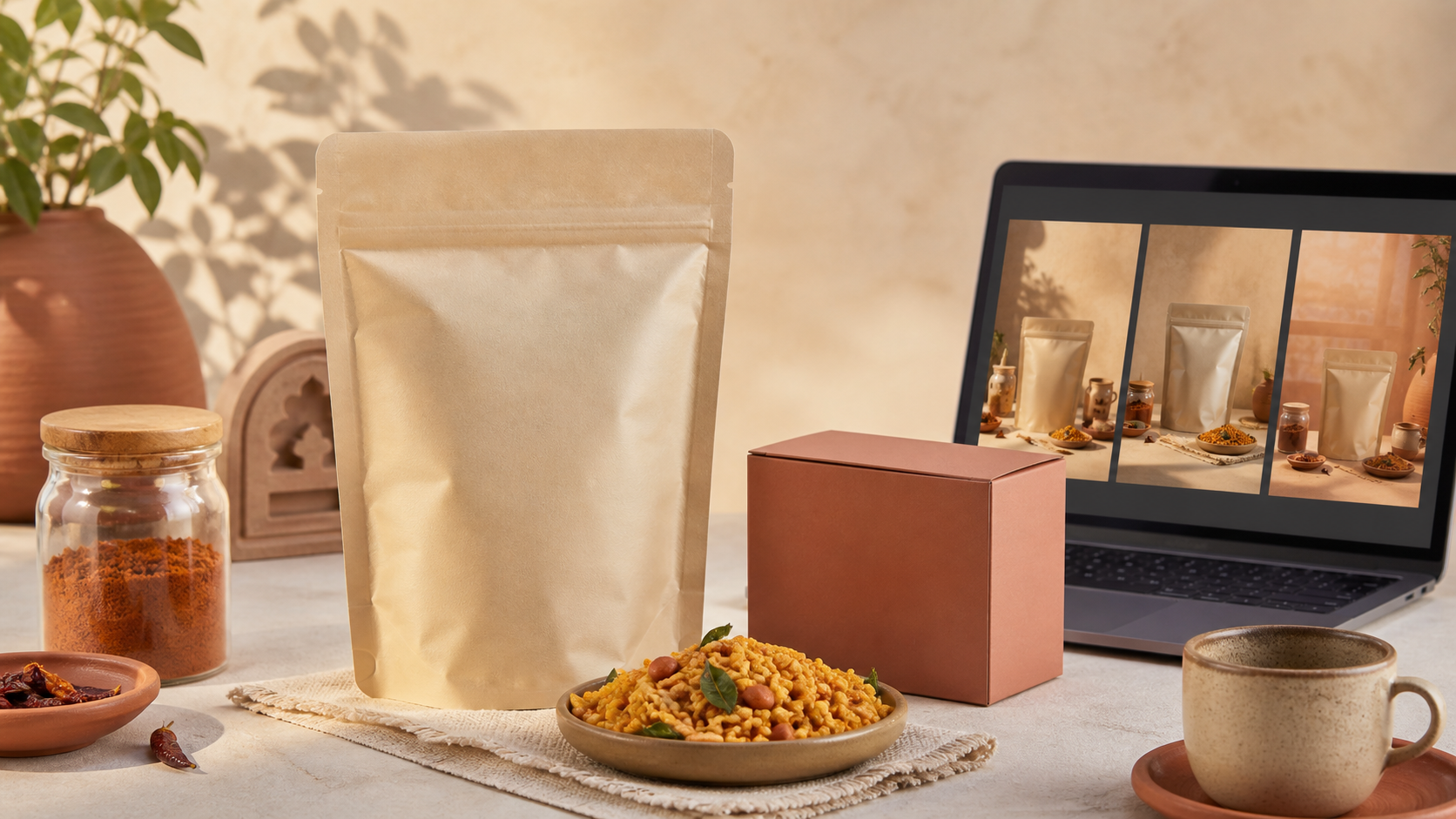
Packaged Indian foods and serving scenes in an AI food product photography workflow

What is AI food product photography?

AI food product photography is a controlled workflow for placing approved photos of packaged food, beverages, ingredients, or prepared servings into new backgrounds, table settings, crops, and ad layouts. AI changes presentation, not product truth: the SKU, label, pack size, ingredient appearance, portion, colour, and texture must still match what a customer receives.

Keep a clean packshot and a real prepared-serving photo as separate reference masters

Use AI for backgrounds, props, crops, seasonal settings, and campaign variations

Keep nutrition, ingredient, certification, and health text from the approved artwork only

Start with /blog/ai-product-photography-for-ecommerce-india for the broader PDP workflow

What is the fastest safe workflow for AI food photos?

Use a six-step sequence: approve the real SKU, capture the food, define the image job, lock product facts, generate a small batch, and compare every output with the references. This gets one useful listing or ad image approved faster than generating dozens of attractive scenes that later fail packaging or food-fidelity review.

1. Photograph the front, back, sides, seal, and size of the current retail pack

2. Photograph a normal serving under neutral light, including the texture buyers will see

3. Choose one job: PDP support, marketplace image, recipe context, flavour cue, or paid-social hook

4. Lock pack geometry, artwork, quantity, ingredients, food colour, texture, and portion

5. Generate three to five scene variations without changing the product description

6. Review the winner beside the physical SKU at full size and on a phone

How do you photograph the source food and packaging?

The reference set should show both commercial truth and sensory truth. Use diffused light for the sealed pack so the logo area, material, edges, cap, seal, and label remain clear. Photograph the actual food separately at the serving temperature and preparation method customers use; an AI model cannot recover texture or colour that the source never shows.

Capture a straight front image plus a three-quarter angle that explains pack depth

Keep label artwork as a controlled design layer instead of asking AI to reproduce readable text

Show powders, grains, sauces, snacks, or beverages close enough to judge real texture

Record the honest serving size, vessel, preparation, garnish, and consistency

Create a clean cutout first with /blog/ai-background-remover-product-photos-india when the source background is distracting

How do you prompt AI food photography without changing the product?

Write the prompt in three blocks: locked product facts, editable scene choices, and forbidden changes. Describe the uploaded pack and food first, choose one Indian buyer-relevant setting, then state what cannot be invented. Add typography and legal copy later in a layout tool because generated label text is not a reliable source of truth.

Lock: exact container, silhouette, cap or seal, artwork placement, food type, colour, texture, and portion

Scene: kitchen counter, breakfast table, office snack, festive tray, cafe table, or neutral studio

Camera: one crop, believable lens, controlled depth of field, and space for a designed headline when needed

Light: soft daylight or another direction that reveals rather than hides texture

Forbid: altered labels, extra ingredients, impossible splashes, oversized portions, false steam, and invented claims

Use /blog/ai-product-photography-prompts-india for reusable prompt structures

Which food details must pass the fidelity check?

A food image passes only when a reasonable buyer would not infer a different pack or eating experience. Compare pack shape and artwork, net quantity cues, ingredient visibility, serving size, colour, thickness, crumb, bubbles, garnish, and preparation result. Reject beautiful images that imply more pieces, richer ingredients, or a texture the actual product does not deliver.

Pack: current SKU, container proportions, closures, material, artwork location, and variant colour

Food: real colour, piece count, thickness, viscosity, crumb, coating, and ingredient distribution

Serving: believable portion, preparation method, vessel scale, and temperature cues

Claims: only approved wording supported by the product and reviewed for the intended placement

Context: props may explain flavour or usage but must not imply ingredients that are absent

When should food brands use real, AI-assisted, or generated images?

Use real photography wherever the image acts as product evidence. Use AI-assisted scenes when the source pack and food can be preserved while context changes. Reserve expressive generated work for campaign exploration, then replace or rigorously validate any element that could affect a purchase decision.

Main PDP packshot: real studio photo or precise retouch of the current SKU

Label, ingredient, nutrition, seal, and texture detail: real close-up

PDP lifestyle or recipe context: AI-assisted after pack and serving review

Marketplace image: follow current platform rules and keep all visual claims verifiable

Paid-social static: use the approved product visual, then add offer and copy in /dashboard/static-ads

Why do AI food product photos look fake?

AI food photos look fake when polish replaces physical logic. Common failures include unreadable packaging, repeated snack pieces, plastic texture, impossible liquid splashes, mismatched shadows, floating garnish, and portions that ignore the container. Fix the source reference and simplify the scene before adding more adjectives to the prompt.

Wrong label or pack: composite the approved packshot instead of regenerating it

Plastic-looking food: use a real macro reference and softer, directional light

Impossible abundance: specify an honest serving and reject duplicated pieces

False ingredient cue: remove decorative fruit, nuts, spices, or herbs not justified by the product

Broken steam or splash: use a calmer moment that the model can render consistently

Busy scene: reduce props until the product, appetite cue, and intended use are obvious on a phone

Food product photography decision table

Image job
Best production method
Must-pass check
Main PDP packshot
Real studio photo or precise retouch
Current SKU, exact artwork, shape, colour, and quantity
Food texture or ingredient detail
Real macro photo
Representative colour, texture, piece size, and consistency
Serving or recipe context
Real or controlled AI-assisted scene
Honest preparation, portion, ingredients, and result
Marketplace supporting image
Compliant composite
Current platform rules and verifiable visual claims
Seasonal campaign visual
AI-assisted scene with approved pack
Product remains exact; props do not imply false ingredients
Paid-social static
Approved product visual plus designed layout
Phone clarity, claim review, offer, and CTA

Best For

Indian food and beverage brands expanding PDP and campaign imagery

Catalog teams producing regional, seasonal, or usage-context variations

Performance marketers turning approved food visuals into static ads

Brands testing scene directions before commissioning a larger shoot

Not Ideal For

Regenerating mandatory label, nutrition, ingredient, or certification text

Inventing ingredients, serving results, pack quantities, or health claims

Replacing real texture and preparation evidence on a high-consideration PDP

Publishing outputs without packaging, food-fidelity, and claim review

Examples

Snack pouch: keep pouch size, flavour artwork, real piece shape, coating, and honest serving count while testing office and travel scenes.
Spice jar: preserve powder colour, grind, jar geometry, fill level, cap, and approved label; use whole spices only when they truthfully clarify the blend.
Tea or coffee: retain the current pack and real brewed colour; avoid invented foam, ingredients, or performance claims.
Sauce bottle: keep viscosity, colour, cap, fill level, and serving amount consistent across kitchen and meal contexts.

FAQs

Can AI create food product photos?

Yes. AI can create backgrounds, serving contexts, crops, and ad variations from approved food and packaging references. Keep the real SKU and representative serving as the source of truth, and reject any output that changes artwork, quantity, ingredients, colour, texture, or portion.

What photos do I need before generating AI food scenes?

Capture the current sealed pack from the front and at an angle, important label or closure details, the actual food at close range, and a normal prepared serving. Record pack dimensions, serving size, preparation, colour, texture, and details the model must preserve.

How do I make AI food photos look realistic?

Use real macro references, lock the pack and food details, choose one simple scene, keep portions honest, and make shadows, reflections, temperature cues, and props physically consistent. Review the output beside the physical product before publishing.

Can AI food photography replace a studio shoot?

It can reduce the number of background and campaign variations, but it should not replace the accurate main packshot, readable label artwork, real texture details, or representative serving evidence. Use real photography for product truth and AI for controlled context.

What is the best AI food image to create first?

Create one supporting image that answers the biggest buyer question: what the food looks like served, how it fits a routine, or which occasion it suits. Lock the real pack and serving first, then adapt the approved image into a PDP visual or static ad.

Can AI product photography replace a studio shoot?

For ecommerce testing, PDP refreshes, lifestyle scenes, and paid social variants, AI product photography can reduce dependence on studio shoots. High-stakes hero campaigns may still need a real shoot.

Is AI product photography useful for Indian marketplaces?

Yes, especially for lifestyle scenes, social ads, secondary PDP images, and category-specific visuals. Marketplace main images may still need strict compliance checks.

Can I generate product videos from one image?

Yes. A product image can guide the product appearance while the prompt defines the scene, creator, camera movement, and action.