Creator Brief Template

UGC Creator SourcingBy Indian UGC Team10 min read

UGC Brief Template for Indian Brands and Creators

A UGC brief should give the creator one audience, one buyer hesitation, one hook, one product action, a short shot list, claim guardrails, deliverables, deadline, revisions, and intended usage. Keep it to one page. If a field does not change what the creator films or delivers, remove it.

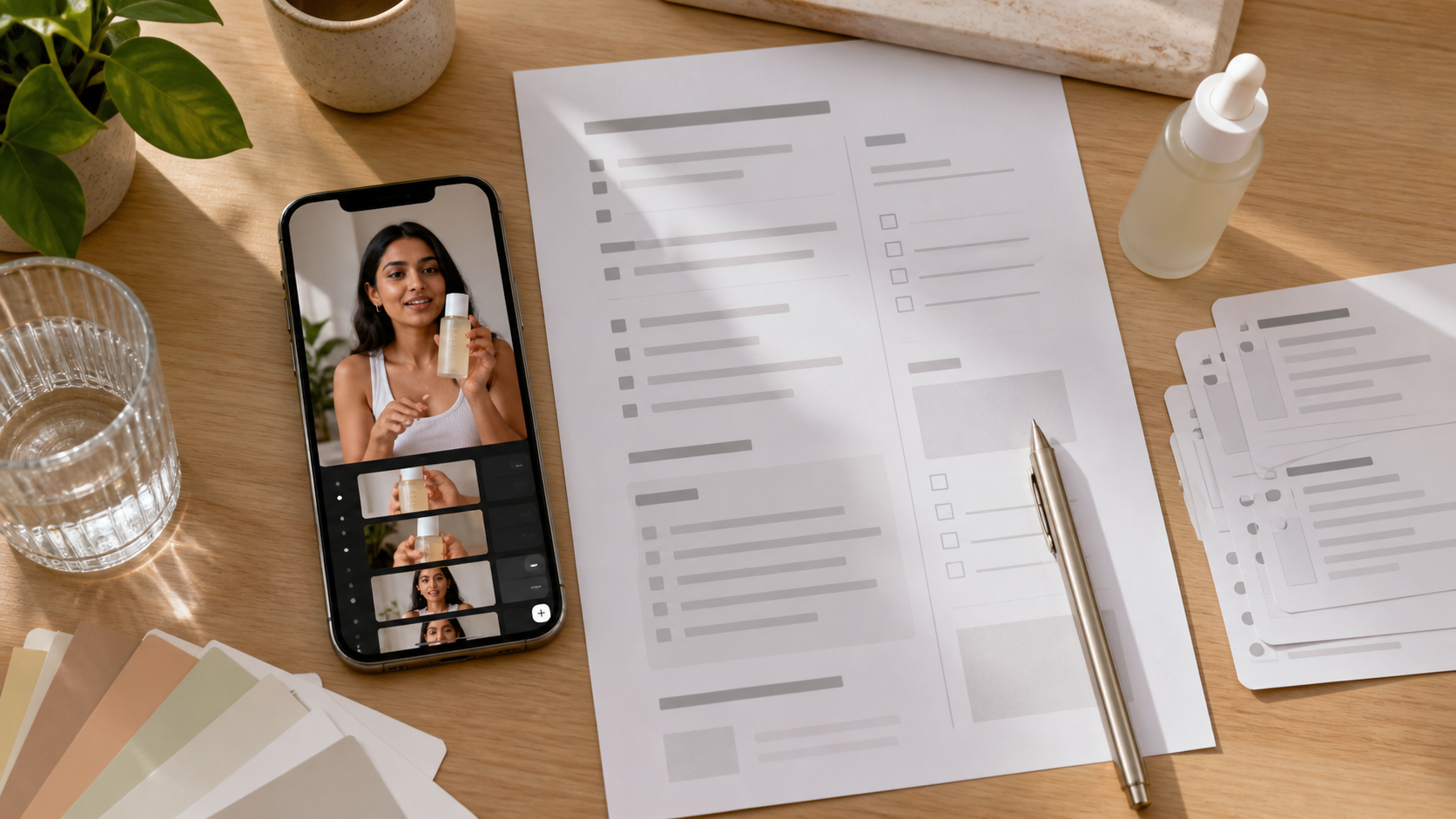
Indian UGC production desk with a creator video storyboard, product sample, and one-page brief checklist

What is a UGC creator brief?

A UGC creator brief is the production plan a brand approves before filming. It translates a campaign idea into specific lines, shots, product actions, deliverables, and review rules. Unlike a broad ad creative brief, it tells one creator exactly what to make while leaving enough room for natural delivery.

Use /blog/ad-creative-brief-template-india to choose the audience, hesitation, angle, and format before writing the creator handoff.

Check typical scope and pricing with /blog/ugc-creator-rates-india.

Put usage, payment, and ownership terms in /blog/ugc-creator-contract-india rather than hiding them in creative notes.

Test the hook and scene in /dashboard/ugc-video before paying for a full shoot.

What should a UGC brief include?

A useful UGC brief includes the objective, audience, buyer hesitation, single message, hook, product action, shot list, spoken points, CTA, visual references, claim guardrails, deliverables, deadline, and reviewer. Add usage rights and payment as linked commercial terms, not vague assumptions.

Objective: the action this asset should drive, such as a product-page visit or trial purchase.

Audience and hesitation: one specific buyer and the doubt blocking action.

Hook and proof: what happens in the first three seconds and what makes the claim believable.

Product action: the exact unboxing, application, pour, fit, texture, setup, or result the viewer must see.

Deliverables: duration, aspect ratio, edited cuts, raw clips, captions, hook variants, and file format.

Guardrails: approved claims, forbidden claims, pronunciation, label accuracy, disclosure, and competitor rules.

What is the fastest copy-paste UGC brief template?

The fastest template uses 12 short fields. Fill it in during a 15-minute call, attach only essential references, and ask the creator to flag anything that feels unnatural before filming. Approval should happen on the brief and script first, because reshooting is slower than rewriting.

Campaign job: [one conversion or learning goal]

Audience: [who they are and what they already know]

Hesitation: [one doubt the video must remove]

Core message: [one sentence the viewer should remember]

Hook: [spoken line or first-frame action]

Product action: [what the creator visibly does]

Shot list: [three to five required shots in order]

Talking points: [facts to express naturally, not a forced monologue]

CTA: [specific next step]

Guardrails: [claims, words, visuals, and errors to avoid]

Deliverables: [cuts, duration, ratio, raw files, captions]

Timeline and review: [draft date, approver, revisions, final date]

How detailed should a UGC script and shot list be?

Specify mandatory facts and visual beats, but do not script every breath. A strong brief locks the opening, product truth, proof moment, CTA, and prohibited claims while letting the creator use natural phrasing. For demonstrations, describe what the camera must prove instead of asking for generic lifestyle footage.

Skincare: show packaging, texture, amount used, application, and routine timing; do not invent medical or guaranteed-result claims.

Food: show sealed pack, preparation or serving action, texture, and taste reaction; keep ingredient claims accurate.

Fashion: show front, back, fabric movement, fit detail, and occasion; never conceal a materially different product.

Apps: show a readable, current screen flow and the actual outcome; avoid fake UI or impossible features.

Turn the approved beats into a timed script with /blog/ugc-script-template-india.

How do you prevent revisions and unusable footage?

Prevent revisions by defining the rejection conditions before filming. Ask for a quick framing or script check, name one final approver, and separate creator errors from new brand requests. Require clean raw clips when the brand expects hook swaps, subtitles, crops, or regional edits later.

Reject before filming: wrong SKU, unsupported claim, unnatural script, missing disclosure, or unavailable location.

Reject after delivery: inaudible speech, unreadable product, missing required shot, wrong ratio, or clipped CTA.

Treat a new concept, language, hook, location, or deliverable as extra scope rather than a normal revision.

Review the finished asset with /blog/ad-creative-audit-checklist-india before launch.

When should you use a real creator or AI UGC?

Use a real creator when genuine product handling, a recognisable identity, lived experience, or audience distribution matters. Use AI UGC to test hooks, personas, settings, and languages before a shoot, or to refresh controlled variants. Never present an invented testimonial as a real customer experience.

Real creator: tactile demos, taste reactions, try-ons, authentic testimonials, and creator-handle distribution.

AI UGC: early concept tests, script pacing, scene alternatives, multilingual drafts, and rapid hook variants.

Hybrid workflow: test three controlled drafts, select one pattern, then give the winning brief to a real creator.

Disclosure note: ASCI's influencer advertising guidance covers disclosure where there is a material connection, ascionline.in/guidelines/influencer-advertising-in-digital-media/.

UGC brief decision table

Brief decision
Lock before filming
Leave flexible
Message
Buyer hesitation, product truth, CTA
Natural connecting words
Opening
Hook idea and first-frame product visibility
Creator's conversational delivery
Shots
Required proof moments and product accuracy
Minor camera movement and transitions
Claims
Approved facts, disclosures, forbidden promises
Claim-safe personal phrasing
Delivery
Count, duration, ratio, raw files, deadline
Optional alternate takes
Revisions
Included rounds and rejection conditions
Small performance adjustments

Best For

Indian D2C teams commissioning creator-made paid-social assets

Agencies standardising creator handoffs and approvals

Creators who want clear scope before quoting and filming

Performance marketers testing hooks without repeated reshoots

Not Ideal For

Replacing a signed contract, usage-right agreement, or legal review

Forcing creators to make unverified testimonials or regulated claims

Copying a competitor, celebrity, or creator identity

Requesting unlimited revisions without additional scope and payment

Examples

Skincare: a 20-second bathroom-routine video with texture close-up, one approved benefit, no medical promise, and product-page CTA.
Snack brand: an office chai-break video with pack visible in the first frame, opening-and-taste shots, and a trial-pack CTA.
Fashion: a mirror try-on with front, back, movement, fabric detail, fit notes, and two hooks for paid-social testing.
Home utility: a before-state, one clear product action, clean reveal, voiceover, and raw clips for later static retargeting ads.

FAQs

What is a UGC brief?

A UGC brief is a production document that tells a creator what the video must achieve, show, say, avoid, and deliver. It covers the audience, hesitation, hook, product action, shot list, talking points, CTA, guardrails, files, deadline, and review process.

How do I write a brief for a UGC creator?

Define one audience and hesitation, choose one message, write the hook and required product action, list three to five shots, add claim guardrails, specify deliverables and dates, then get script or concept approval before filming.

Should a UGC brief include a full script?

Include exact wording for mandatory claims, disclosures, pronunciation, and CTA. For the rest, give talking points and visual beats so the creator can sound natural. Approve the planned phrasing before filming when the category has sensitive claims.

What is the difference between a UGC brief and a contract?

The brief defines the creative output: message, script, shots, product action, and review rules. The contract defines the commercial and legal terms: payment, ownership, paid usage, edit rights, exclusivity, revisions, cancellation, and renewal.

How long should a UGC creator brief be?

Keep the core brief to one page when possible, plus essential product references or a short storyboard. A creator should be able to identify the required hook, proof, shots, CTA, guardrails, and deliverables in a few minutes.

Can AI UGC replace real creators?

AI UGC is best for fast creative testing, early campaign drafts, hook exploration, and low-cost content volume. Real creators still matter for influencer distribution, creator trust, and testimonial rights.

Does AI UGC work for Indian audiences?

It can work well when the prompt includes Indian personas, local language, realistic home settings, product-in-hand moments, and duration-safe dialogue instead of generic global stock-style scenes.

What assets do I need to start?

A product name, a short product brief, and ideally one clean product image are enough to generate the first AI UGC video or product visual.