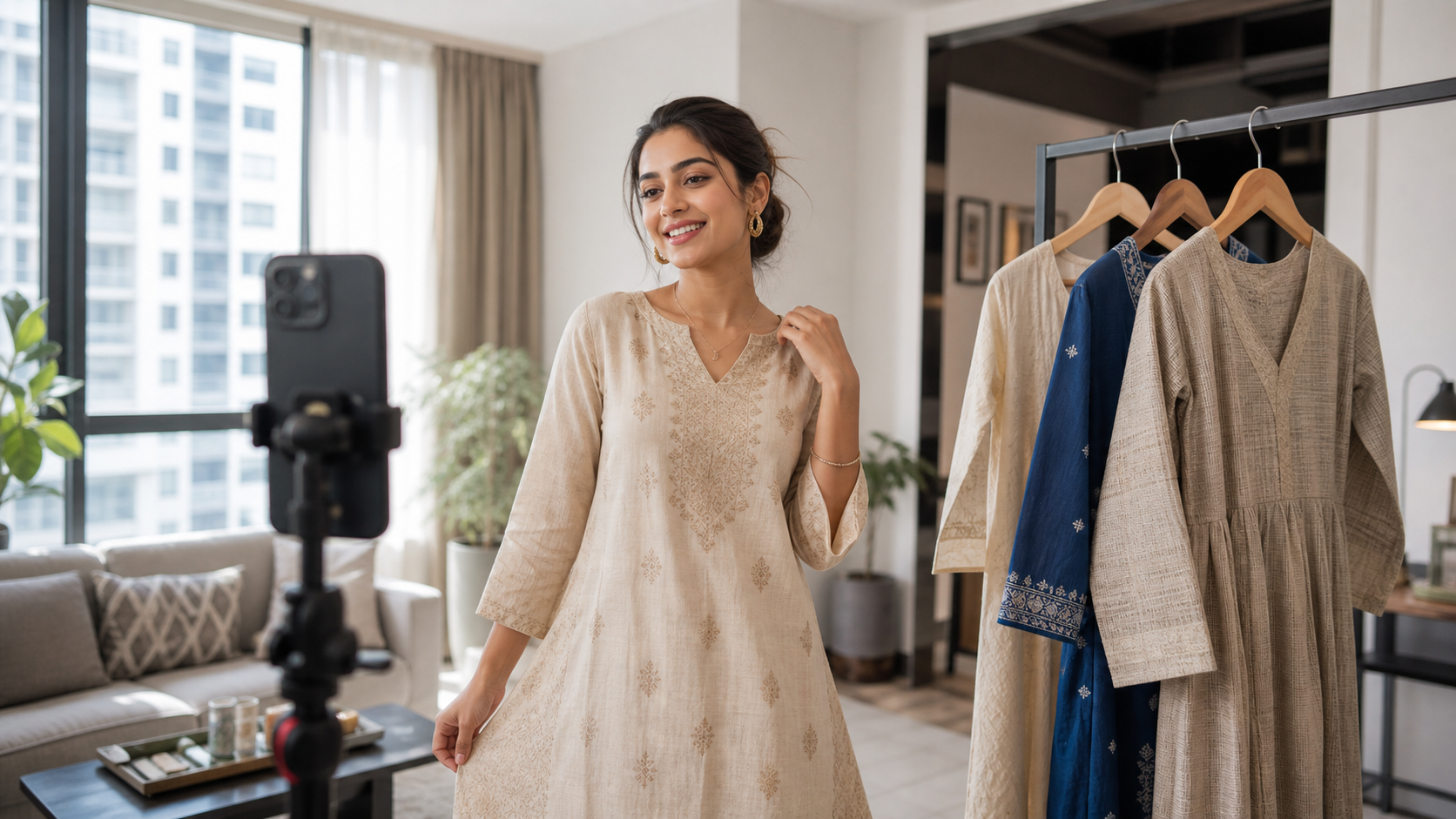
What are UGC ads for fashion brands?
UGC ads for fashion brands are creator-style videos that show clothing, footwear, or accessories in an everyday buying context rather than a polished campaign set. A useful fashion UGC ad behaves like a compact fitting-room answer: it shows the item clearly, demonstrates movement or styling, resolves one hesitation, and gives the shopper a specific next step.
Fit check: show the front, side, back, and one natural movement.
Fabric check: use a close-up and motion that reveal drape, texture, or structure.
Styling check: build one complete outfit around the hero SKU.
Occasion check: place the garment in a believable office, festive, travel, or everyday context.
For the broader ad format, read /blog/what-are-ugc-ads.
What is the fastest fashion UGC video to make first?
Make a six-shot try-on for one garment: hook, full look, detail, movement, styling option, and CTA. Keep each shot responsible for one visual fact. This structure reduces production effort because the same footage can become a 15-second cut, a longer review, and several static frames without asking one generated clip to preserve the garment through complicated choreography.
Hook: name the hesitation, such as ‘Will this look boxy on me?’
Full look: show the complete silhouette with the camera still.
Detail: move close enough to inspect fabric, stitching, neckline, or fastening.
Movement: use one walk, turn, sit, or sleeve movement.
Styling option: change one layer or accessory, not the garment itself.
CTA: use an approved product, collection, size-guide, or offer direction.
How do you prompt an AI UGC fashion ad?
Describe the creator, exact garment reference, one setting, one camera position, one action, and one spoken idea. Treat the uploaded product image as the identity anchor, not loose inspiration. Ask for realistic skin and fabric, restrained movement, and no invented labels or text. Generate separate shots when the concept needs several views, then assemble the final ad in editing.
Creator: age range, presentation, and natural styling relevant to the buyer.
Garment: category, colour, print, neckline, sleeve, hem, fastenings, and fit.
Scene: one Indian bedroom, mirror area, hallway, office, or outdoor context.
Action: one turn, walk, fabric touch, bag pairing, or footwear change.
Dialogue: one short buyer-facing line that can fit the clip naturally.
Use /blog/ugc-video-generator-prompts-india for a reusable prompt structure.
How do you stop AI fashion videos from changing the product?
Reduce visual ambiguity and motion. Use a clean front or three-quarter product reference, keep the garment large in frame, request one controlled action, and reject outputs against a written product checklist. AI may preserve the overall outfit while quietly changing a print, button count, hem, jewellery detail, or bag hardware; those small errors can make the ad commercially unusable.
Compare colour under neutral light; do not approve from a stylised grade alone.
Freeze the print scale, motif placement, logo position, and visible labels.
Check neckline, sleeves, fasteners, pockets, seams, hem, and garment length.
Check fit separately from styling: relaxed, straight, fitted, cropped, or oversized must not drift.
Use a real macro insert when fabric texture or construction is a purchase-critical fact.
Run the wider review in /blog/ai-ugc-video-generator-review-checklist-india.
Which fashion UGC angle should you choose?
Choose the angle from the shopper's unanswered question, not from a trending transition. Fit uncertainty needs a try-on; quality uncertainty needs fabric and construction detail; styling uncertainty needs an outfit formula; occasion uncertainty needs context. A narrow ad is easier to believe, review, and test than a montage claiming to answer every concern at once.
New silhouette: lead with a full-body fit check and movement.
Premium fabric: lead with drape, texture, finishing, and care context.
Versatile basic: show one garment in two restrained styling directions.
Festive product: show the complete look, then workmanship details and movement.
Footwear or bag: show scale, carrying or walking context, closure, and capacity where relevant.
For more buyer-led concepts, use /blog/d2c-ad-creative-angles-india.
How should fashion brands test UGC video ads?
Test one creative question at a time. Keep the SKU, offer, landing page, creator, and core demonstration stable while changing the opening hesitation. Once a hook wins, test the proof style or creator context. This produces learning the next brief can use; five unrelated outfits, hooks, and offers only tell you that five different ads performed differently.
Round one: fit, fabric, and styling hooks for the same SKU.
Round two: keep the winning hook and compare full-look, detail, or movement proof.
Round three: adapt the winner into English, Hinglish, or a relevant regional-language direction.
Cut vertical-first, but keep faces, garment details, and captions inside platform-safe areas.
Meta recommends vertical 9:16 creative with key messages kept in the safe zone for Reels placements: facebook.com/business/ads-guide/update/video/instagram-reels.
Plan controlled iterations with /blog/meta-ad-creative-testing-calendar-india.
When should a fashion brand use real creators instead?
Use real creators when the ad depends on a truthful personal fit experience, body-specific sizing advice, a testimonial, creator distribution, whitelisting, or a detailed product demonstration that generation cannot preserve. AI UGC is strongest for concept drafts, hook exploration, scene planning, and controlled creative refreshes—not fabricated customer experience.
A real try-on is safer when shoppers need dependable sizing context across body types.
A real macro shot is better when weave, stretch, lining, transparency, or finish drives the purchase.
A real creator is required when the message claims their personal experience or endorsement.
ASCI's influencer advertising guidelines explain disclosure expectations for material connections: asci.social/guidelines.
Use /blog/ugc-creator-brief-template-india when the concept moves to creator production.