Hinglish Ad Scripts

Regional UGCBy Indian UGC Team11 min read

Hinglish UGC Ads for Indian D2C Brands

Hinglish UGC ads combine conversational Hindi and English the way the target buyer naturally speaks. Use Hinglish when your audience understands English product terms but responds better to Hindi emotion, context, or objections. Keep one buyer problem, one visible product action, and one CTA; then test the same concept in English, Hinglish, and Hindi.

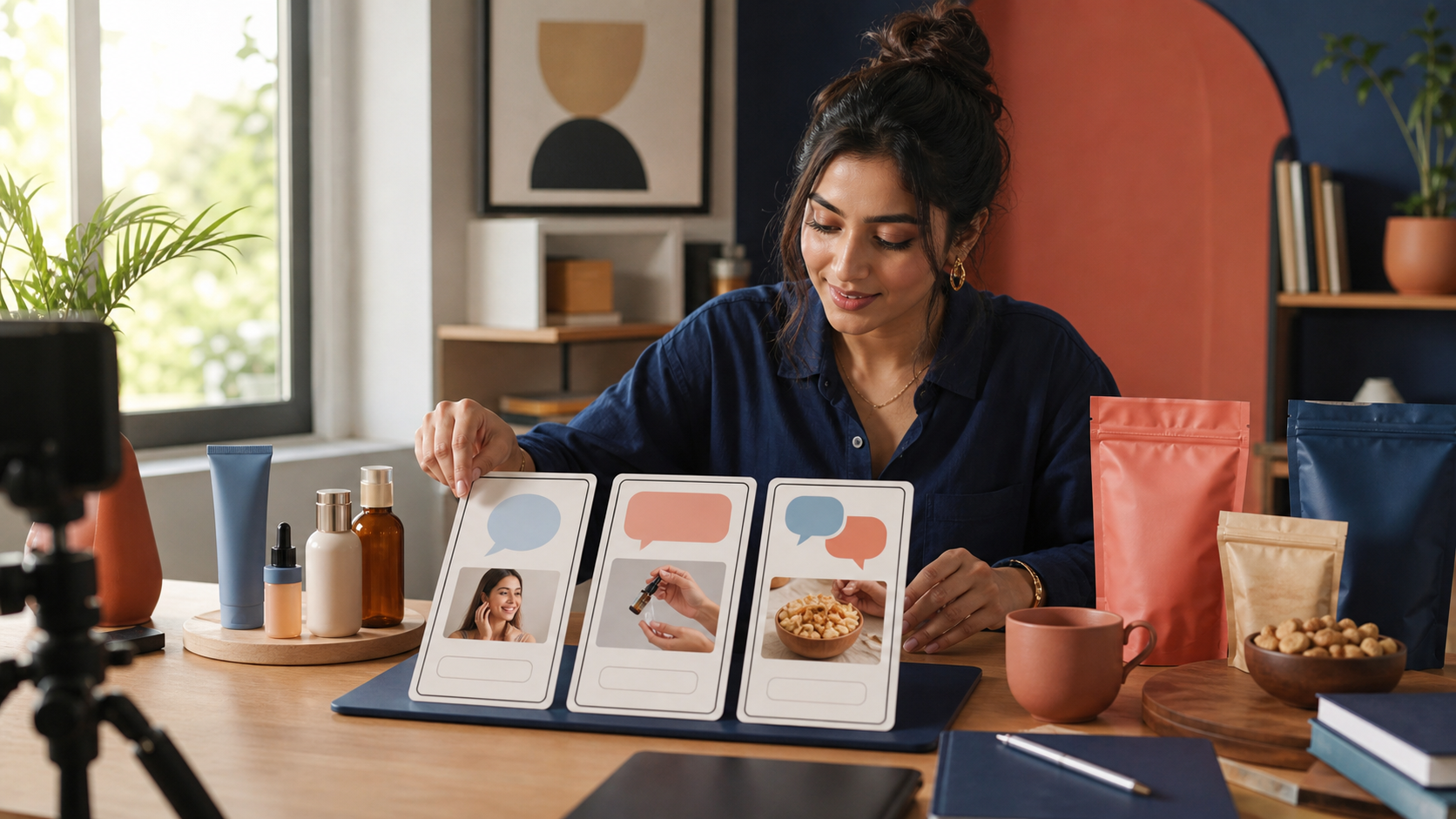
Indian creator planning English, Hindi, and Hinglish UGC video ad variants at a home studio desk

What is a Hinglish UGC ad?

A Hinglish UGC ad is a creator-style video that naturally code-switches between Hindi and English while showing a product in use. English often carries familiar category words such as serum, checkout, fit, protein, or subscription; Hindi carries the reaction, objection, recommendation, or everyday context. The result should sound spoken, not translated.

Start with the broader language-selection framework: /blog/regional-language-ugc-ads-india

Use the Hindi-first playbook when household trust or wider North India reach matters more: /blog/hindi-ugc-ads-ecommerce-india

Use script structures and hooks from /blog/ugc-video-script-examples-india

Generate the first controlled video draft in /dashboard/ugc-video

When should a brand choose English, Hindi, or Hinglish?

Choose the language from how buyers describe the product, not from the founder's preference. Start with Hinglish when reviews, comments, calls, and creator content mix Hindi sentences with English category terms. Choose English for English-first audiences or technical products, and Hindi-first language when familiarity, family use, value, or household trust drives the purchase.

English-first: premium, technical, B2B, or metro audiences already using English category language

Hinglish-first: beauty, food, fashion, fitness, gadgets, home, and everyday D2C products for mixed-language metro and North India audiences

Hindi-first: household, value, family-use, education, food, wellness, or wider Hindi-belt campaigns

Regional-first: strong state-level order clusters; use /blog/regional-language-ugc-ads-india instead of forcing Hinglish everywhere

Fast rule: use the language mix already present in customer reviews and support conversations

How do you write a natural Hinglish UGC script?

Write the meaning before mixing languages. Begin with the buyer's real hesitation, show one product action, add one believable reason to care, and finish with one next step. Read the script aloud. If a phrase sounds like a dubbed television commercial, formal Hindi lesson, or corporate English deck, replace it with the shortest line your buyer would actually say.

Problem hook: “Morning mein routine complicated ho jaata hai, so I wanted one simple step.”

Demo line: “Texture lightweight hai—dekho, blend hone mein seconds lagte hain.”

Value line: “Price pehle high laga, but per-use cost actually kaafi sensible hai.”

Comparison line: “Heavy option nahi chahiye tha; this fits my everyday routine better.”

CTA line: “Agar same problem hai, details check kar lo before you choose.”

For a reusable brief, adapt /blog/ugc-creator-brief-template-india

What prompt creates a better Hinglish AI UGC video?

Give the generator one Indian creator persona, one realistic setting, one product action, one short Hinglish line, and one CTA. State which words should remain English only when the category naturally uses them. Do not request a long monologue, several locations, fake accents, celebrity imitation, or critical readable text inside the generated video.

Prompt skeleton: Indian [persona] in [setting], visibly [product action], says one natural Hinglish line about [buyer objection], then gives [CTA]

Keep product pack, label, colour, texture, and usage consistent with the approved reference

Ask for vertical mobile framing with the product visible early

Meta's video guidance emphasizes mobile-ready creative: facebook.com/business/ads/video-ad-format

Google's ABCDs framework emphasizes attention, branding, connection, and direction: support.google.com/google-ads/answer/14783551

How should you test Hinglish ads without wasting budget?

Run a controlled language test. Keep the creator persona, opening visual, product action, offer, length, landing page, and audience stable. Change only the spoken language mix. Compare English, Hinglish, and Hindi on early attention, qualified clicks, landing-page behaviour, and purchases—not just cheap views.

Round one: same hook meaning in English, Hinglish, and Hindi

Round two: keep the winning language and test two buyer objections

Round three: keep the winning objection and test the CTA or creator persona

Use /blog/ad-creative-testing-india for a disciplined testing loop

Use /blog/ad-creative-audit-checklist-india before scaling a apparent winner

Why do Hinglish UGC ads fail?

Hinglish ads fail when every sentence switches language for effect, the Hindi sounds formal, English jargon replaces clarity, or the creator speaks while nothing useful happens on screen. Another common failure is changing the language, hook, persona, offer, and edit together—leaving the team unable to tell what improved performance.

Forced slang: use the buyer's vocabulary, not internet catchphrases added by the brand

Literal translation: rewrite for spoken rhythm instead of preserving every English word

Overloaded script: one objection and one demonstration beat five feature claims

Weak evidence: show the product action instead of making an unsupported testimonial claim

Uncontrolled test: change one major variable per comparison

English vs Hinglish vs Hindi UGC ad decision table

Audience signal
First language test
Script direction
English-first reviews and technical product terms
English
Explain one use case clearly; avoid adding Hindi only to appear local
Hindi sentences with familiar English category words
Hinglish
Keep product terms in English and express the objection naturally in Hindi
Family-use, value, or household-trust purchase
Hindi-first
Use simple spoken Hindi with only necessary English product terms
Mixed metro and North India paid traffic
English vs Hinglish
Keep the same product action and compare only the spoken line
Strong state-level order cluster
Regional language
Move to the relevant regional guide instead of treating Hinglish as pan-India
Retargeting after an English winner
Hinglish
Reuse the winning visual and localize one objection plus CTA

Best For

Indian D2C brands whose buyers naturally mix Hindi and English

Metro and North India performance campaigns

Beauty, food, fashion, fitness, gadgets, home, and routine-led products

Teams localizing a proven English concept without reshooting every variant

Not Ideal For

Using Hinglish as a substitute for state-language research across all of India

Formal translations, forced slang, or exaggerated accents

Celebrity, influencer, or real creator impersonation

Medical, financial, legal, or regulated claims without category review

Examples

Skincare: “Routine already long hai, so I wanted one lightweight step.” Show one application and texture close-up.
Snack: “Chai ready hai, but mujhe kuch actually crunchy chahiye tha.” Open the pack and show one bite.
Fashion: “Office se dinner jaana ho, this fit makes it easy.” Show fabric, fit, and one styling change.
Home organizer: “Ye drawer main roz avoid karti thi—then I tried this setup.” Show the before, product action, and reveal.
Fitness product: “Setup simple chahiye tha, warna honestly use hi nahi hota.” Demonstrate one safe, accurate action.
Retargeting: “Teen baar ad dekha, then I checked what it actually does.” Put the product demonstration immediately after the line.

FAQs

What is a Hinglish ad?

A Hinglish ad mixes conversational Hindi and English in the way its intended buyer naturally speaks. Strong Hinglish UGC keeps familiar product terms in English while using Hindi for context, objections, reactions, or recommendations, alongside a clear product demonstration.

Are Hinglish UGC ads better than Hindi ads?

Hinglish is often the better first test for mixed-language metro and North India D2C audiences. Hindi-first ads may work better when household trust, family use, value, or wider Hindi-belt reach matters. Test both with the same concept and product action.

How long should a Hinglish UGC script be?

Use the fewest lines needed to communicate one hook, one product action, one reason to care, and one CTA. For a short paid-social draft, one buyer objection and one demonstration are usually more useful than a list of features.

Can AI generate Hinglish UGC videos?

Yes. Give the AI one creator persona, one realistic Indian setting, one product action, one short Hinglish line, and one CTA. Review pronunciation, language naturalness, product accuracy, claims, crop, and landing-page consistency before publishing.

How do I test English versus Hinglish ads?

Keep the audience, opening visual, product action, offer, duration, and landing page stable. Change only the spoken language mix, then compare attention, qualified clicks, landing-page behaviour, and purchases before testing a new hook or persona.

Can AI UGC replace real creators?

AI UGC is best for fast creative testing, early campaign drafts, hook exploration, and low-cost content volume. Real creators still matter for influencer distribution, creator trust, and testimonial rights.

Does AI UGC work for Indian audiences?

It can work well when the prompt includes Indian personas, local language, realistic home settings, product-in-hand moments, and duration-safe dialogue instead of generic global stock-style scenes.

What assets do I need to start?

A product name, a short product brief, and ideally one clean product image are enough to generate the first AI UGC video or product visual.