Six-Shot Video Plan

AI UGC WorkflowBy Indian UGC Team10 min read

UGC Ad Storyboard Template for Indian D2C Brands

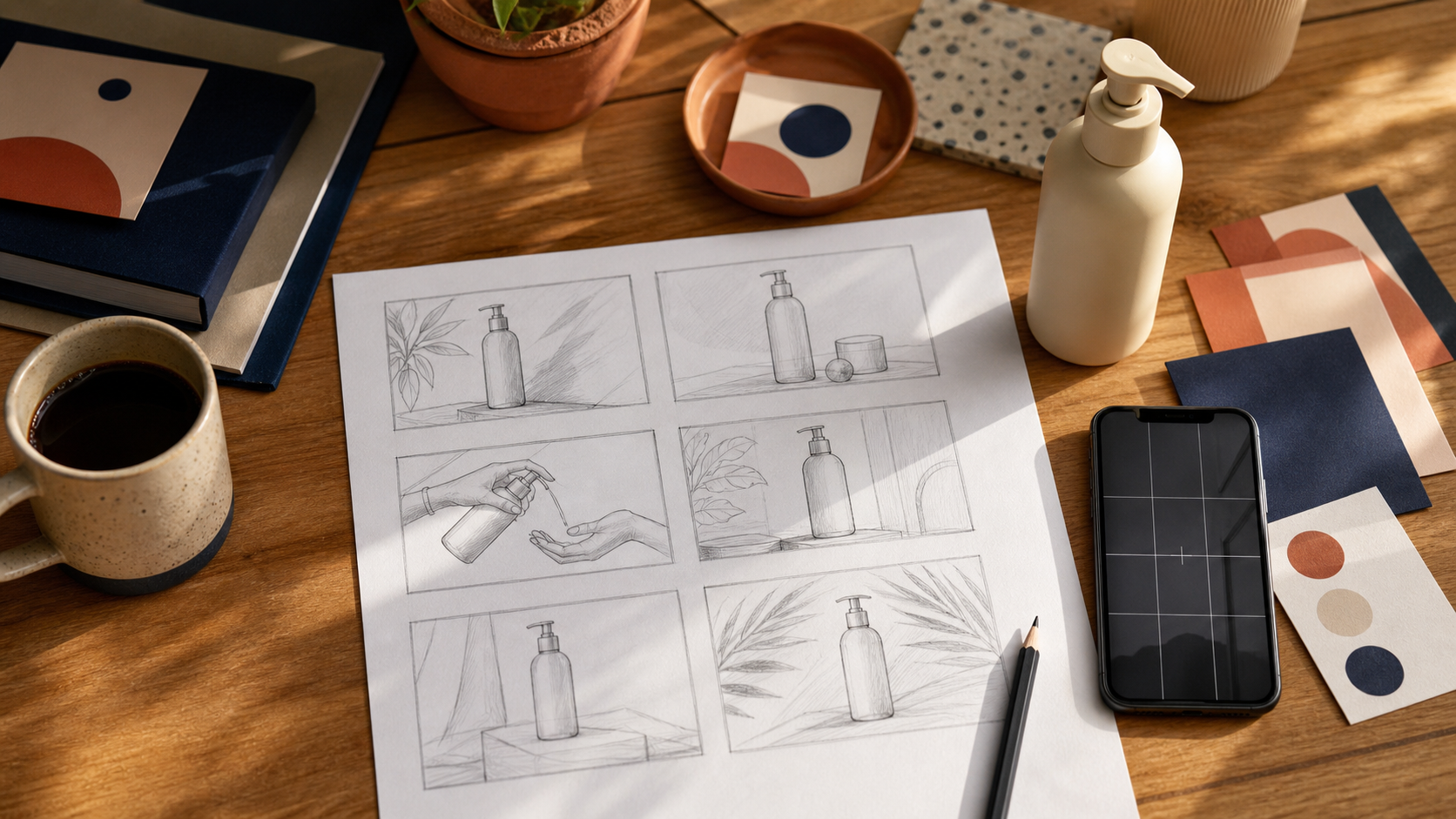
A useful UGC ad storyboard maps one buyer problem into six shots: pattern-interrupt hook, problem context, product reveal, product-in-use proof, benefit payoff, and CTA. Keep one creator, one location, and one product action throughout. Write the spoken line, visual action, and on-screen purpose for each shot before generating or filming any footage.

Six-frame UGC ad storyboard beside a smartphone and D2C product on an Indian marketing desk

What is a UGC ad storyboard?

A UGC ad storyboard is a shot-by-shot plan for a creator-style advertisement. It connects what the viewer sees, what the creator says, what the product does, and why each moment exists. Unlike a script alone, the storyboard catches visual gaps before production: a hidden product, an impossible action, a weak proof moment, or a CTA with no supporting shot.

Use the broader message framework in /blog/ugc-script-template-india before dividing the idea into shots

Choose one buyer hesitation with /blog/d2c-ad-creative-angles-india

Turn the approved storyboard into a generation brief at /dashboard/ugc-video

What is the fastest six-shot UGC storyboard template?

Use six jobs, not six random camera angles. Shot one earns attention. Shot two makes the buyer recognise the problem. Shot three reveals the product. Shot four demonstrates one believable action. Shot five translates that action into a concrete payoff. Shot six tells the viewer what to do next. For a 15-to-30-second ad, every shot should carry one idea only.

Shot 1 — Hook: interrupt the scroll with the problem, mistake, or surprising product moment

Shot 2 — Context: show the Indian routine, setting, or frustration the buyer recognises

Shot 3 — Reveal: introduce the product clearly with packaging visible

Shot 4 — Proof: demonstrate one real action, texture, fit, setup, or use moment

Shot 5 — Payoff: state the practical benefit without inventing a guarantee

Shot 6 — CTA: give one specific next step that matches the landing page

How do you write each storyboard frame?

Give every frame four fields: visual, dialogue, product action, and purpose. The visual describes only what the camera can capture. Dialogue should be short enough for the shot duration. Product action states exactly what the creator does with the SKU. Purpose explains the single belief the frame must create, making review much faster than debating whether a scene simply looks good.

Visual: close-up at a bathroom mirror in soft morning light

Dialogue: 'My sunscreen kept pilling under makeup.'

Product action: creator holds the correct pack beside her face

Purpose: attract shoppers who recognise the same routine problem

Review rule: if a frame needs two sentences or two product actions, split it or remove one idea

How do you adapt the storyboard for AI UGC?

AI UGC works better when the storyboard becomes a series of simple generation units. Keep the persona, wardrobe, setting, product reference, lighting, and camera direction consistent, but generate complex actions separately. A single clip should usually contain one visible speaker, one product action, and one short spoken line. Assemble approved clips only after checking product fidelity and continuity.

Lock: creator description, location, wardrobe, light, aspect ratio, and product reference

Vary: hook line, opening gesture, proof close-up, language, or CTA — one variable at a time

Avoid: readable generated labels, multiple locations, handoffs between people, and long dialogue in one clip

Review every draft with /blog/ai-ugc-video-generator-review-checklist-india

Plan controlled variants with /blog/ad-creative-testing-india

What should an Indian D2C storyboard include?

Use Indian context only when it helps the buyer recognise the moment. A local setting, routine, price cue, language choice, or familiar use case can improve relevance; decorative stereotypes cannot. Decide whether the ad should be English, Hinglish, Hindi, or regional-language before writing dialogue, then preserve the meaning rather than translating every word literally.

Beauty: mirror, dressing table, commute, humidity, or getting-ready routine

Food: office snack break, family kitchen, chai time, travel, or post-work craving

Fashion: mirror try-on, fabric close-up, office-to-evening change, or festive styling

Home: compact apartment, morning rush, storage problem, or cleaning demonstration

For mixed-language dialogue, use /blog/hinglish-ugc-ads-india as the language checklist

Why do UGC storyboards fail?

UGC storyboards fail when they describe a polished ad without proving the product's role. Common symptoms are a long talking-head opening, a late product reveal, five benefits in one clip, visual actions that cannot be filmed, and a generic 'shop now' ending. Fix the board by removing any frame that does not clarify the problem, product action, proof, or next step.

Too much setup: reveal the buyer problem and product earlier

Weak proof: replace adjectives with a visible texture, fit, setup, or use action

Unclear product: add a clean pack shot and compare it with the real SKU

Risky claims: remove guarantees and unsupported health, beauty, finance, or performance promises

Wrong CTA: make the final line match what the landing page actually offers

Six-shot UGC ad storyboard template

Shot
Visual job
Example line
1. Hook
Show the problem or unexpected product moment
Why did nobody tell me this was causing the mess?
2. Context
Make the buyer recognise the routine
This happened every morning before work.
3. Reveal
Show the product and name its role
I switched to this for one simpler step.
4. Proof
Demonstrate one believable product action
Watch how it applies without the extra fuss.
5. Payoff
Connect the action to a practical outcome
Now the routine feels much easier to repeat.
6. CTA
Give one landing-page-matched next step
See the product details and choose your option.

Best For

Indian D2C founders planning short paid-social videos

Performance marketers testing one creative angle

Agencies briefing creators or AI UGC workflows

Teams that need approval before production

Not Ideal For

Complex multi-location brand films

Ads without a verified product claim or landing page

Storyboards that attempt to test every variable at once

Examples

Skincare: pilling hook, mirror context, pack reveal, texture close-up, smoother routine payoff, product-page CTA.
Snack: 4 p.m. craving hook, office-desk context, pack reveal, first-bite proof, convenient portion payoff, flavour CTA.
Fashion: fit doubt hook, mirror context, garment reveal, movement and fabric proof, styling payoff, size-guide CTA.
Home product: clutter hook, kitchen context, product reveal, one-step demonstration, cleaner counter payoff, demo CTA.

FAQs

How many shots should a UGC ad storyboard have?

Start with six shots for a 15-to-30-second UGC ad: hook, problem context, product reveal, product proof, benefit payoff, and CTA. Shorter ads can combine context with the hook or payoff with the CTA, but the product action and next step should remain clear.

What should I write in each UGC storyboard frame?

Write the visual, spoken line, product action, and purpose for each frame. This makes the storyboard useful to a creator, editor, AI video workflow, and reviewer without requiring them to infer what the shot is supposed to prove.

Should the script or storyboard come first?

Start with the buyer problem, product angle, proof, and CTA, then draft the script and storyboard together. A line that has no useful visual should be rewritten, while a visually attractive shot that adds no message should be removed.

Can I use the same storyboard for AI UGC and a real creator?

Yes, but adapt the production notes. AI clips need simpler actions, continuity locks, short dialogue, and product-fidelity checks. A real creator can often perform longer demonstrations and natural transitions, but still benefits from the same six-shot message structure.

How do I make a UGC storyboard feel Indian without stereotypes?

Choose a real buyer context such as an office routine, compact home, local weather, chai break, commute, language preference, or festival use case only when it supports the product. Avoid decorative cultural cues that do not change the buyer problem or product demonstration.

Can AI UGC replace real creators?

AI UGC is best for fast creative testing, early campaign drafts, hook exploration, and low-cost content volume. Real creators still matter for influencer distribution, creator trust, and testimonial rights.

Does AI UGC work for Indian audiences?

It can work well when the prompt includes Indian personas, local language, realistic home settings, product-in-hand moments, and duration-safe dialogue instead of generic global stock-style scenes.

What assets do I need to start?

A product name, a short product brief, and ideally one clean product image are enough to generate the first AI UGC video or product visual.