Creative Operations

D2C Ad CreativesBy Indian UGC Team10 min read

Ad Creative Workflow for Indian D2C Teams

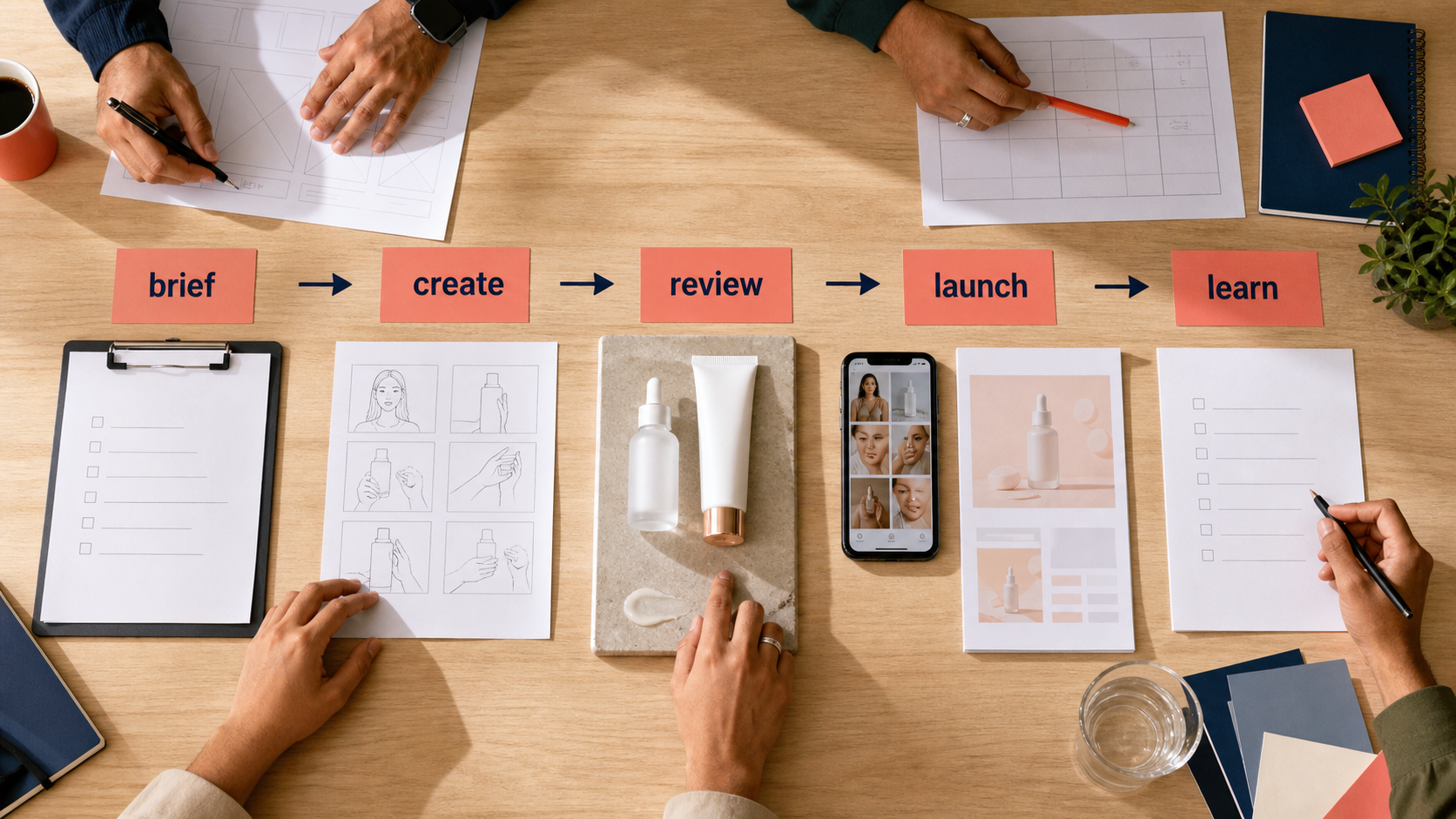
A creative workflow is the repeatable path that moves one advertising idea through insight, brief, production, review, launch, and learning. For a lean Indian D2C team, assign one owner at every stage, keep one source-of-truth brief, review product and claims before polish, and send campaign results back into the next weekly batch. The fastest workflow removes unclear handoffs, not quality checks.

Indian D2C marketing team arranging briefs, UGC video frames, static ads, reviews, and launch steps into a creative workflow

What is a creative workflow for advertising?

A creative workflow is a documented sequence for turning a customer insight into a launched ad and a reusable learning. It defines the input, owner, approval gate, output, and next handoff for every stage. Unlike a creative strategy, which decides what the ad should communicate, the workflow makes sure the brief, UGC video, static creative, review, media launch, and results move without ambiguity.

Insight: one buyer hesitation, question, or observed campaign problem.

Brief: one audience, message, proof moment, offer, format, and CTA.

Production: controlled UGC video or static variants with named test variables.

Review: product truth, claims, message, crop, captions, offer, and landing-page continuity.

Launch and learn: media labels and results that point to the next creative decision.

What is the fastest D2C ad creative workflow?

Use a six-stage flow: diagnose on Monday, approve the brief, produce a small batch, review in one pass, launch with clean names, and record the decision. Keep three to five variants around one question. A single accountable owner should move the batch forward, while product, legal, or founder reviewers approve only the fields that genuinely need their judgement.

1. Diagnose: choose one constraint in attention, understanding, belief, or action.

2. Brief: complete one page using /blog/ad-creative-brief-template-india.

3. Produce: create one baseline and three to five controlled variants.

4. Review: collect feedback against a checklist, not scattered chat messages.

5. Launch: use names that identify concept, hook, format, language, and version.

6. Learn: record what stays, what changes, and who owns the next batch.

Who should own each creative workflow stage?

Give every stage one directly responsible owner, even when several people contribute. The performance marketer owns the test question and launch data; the strategist or founder approves the buyer argument; the creator, designer, or AI operator owns production; and one brand reviewer owns product and claim accuracy. Shared ownership usually means nobody knows whether a batch is ready.

Performance owner: diagnosis, test variable, media setup, result, and next decision.

Brief owner: audience, problem, promise, proof, offer, CTA, and references.

Production owner: script, prompt, frames, edit, file naming, and delivery date.

Brand reviewer: SKU accuracy, approved claims, price, offer, language, and required disclaimer.

Workflow owner: resolves blockers and maintains the source-of-truth status.

How should AI UGC fit into the creative production workflow?

Use AI UGC after the message and product truth are approved but before expensive scale production. It can turn one brief into fast hook, scene, persona, and language drafts, helping the team see weak ideas early. Keep the real SKU, approved claims, offer, CTA, crop, and test variable locked. Human review must reject invented packaging, testimonials, results, prices, or product behaviour.

Start with a clean product reference and one simple action per scene.

Separate locked prompt instructions from the one variable being tested.

Generate creator-style drafts in /dashboard/ugc-video.

Turn approved messages into follow-up cards in /dashboard/static-ads.

Use real creators when personal experience, authentic handling, whitelisting, posting, or testimonial rights matter.

What should the creative review checklist include?

Review truth and test validity before taste. First compare the asset with the real product, approved copy, current offer, and landing page. Then check whether it changes only the declared variable and remains legible on a phone. Give feedback as pass, revise, or reject with one reason and one owner; subjective rewrites from five reviewers create delay without reducing risk.

Product: correct SKU, pack, colour, size, texture, label, quantity, and use.

Message: one understandable promise supported by visible or verifiable proof.

Compliance: approved claims, prices, endorsements, disclaimers, and usage rights.

Format: immediate opening, safe crop, readable captions, clean audio, and visible CTA.

Continuity: the ad promise, offer, and CTA agree with the destination page.

Test validity: every locked element remains stable across the batch.

Why do ad creative workflows become slow or chaotic?

Creative workflows break when the brief lives in several places, reviewers enter after production, feedback has no deadline, and campaign results never return to the people making the next asset. More software will not fix unclear decisions. Reduce the workflow to one brief, one status, one owner per stage, one consolidated review, and one written learning after launch.

Missing input: production starts before the SKU, offer, proof, or CTA is approved.

Feedback sprawl: comments arrive through calls, documents, DMs, and screenshots.

Late compliance: product or claim problems appear after editing is complete.

Random volume: the batch changes several variables and produces no clear lesson.

Broken feedback loop: media results are reported as winners and losers without a reason or next action.

Audit the baseline with /blog/ad-creative-audit-checklist-india and turn the result into a controlled next version with /blog/creative-iteration-d2c-ads-india.

D2C ad creative workflow decision table

Workflow problem
Fix first
Owner
Ideas are vague
One-page brief with one test question
Strategist or performance marketer
Production is slow
Smaller three-to-five-asset batch and locked inputs
Production owner
Reviews keep reopening
One checklist, deadline, and consolidated decision
Brand reviewer
AI outputs drift
Better references, locked prompt block, side-by-side SKU QA
AI operator and brand reviewer
Results create no learning
Record the signal, decision, and next variable
Performance owner
Winning ads wear out
Refresh delivery while preserving the proven argument
Creative and performance owners

Best For

Lean Indian D2C teams producing weekly paid-social assets

Performance marketers who need creative output tied to testable decisions

Agencies coordinating brands, creators, designers, and media buyers

Teams adding AI UGC without weakening product or claims review

Not Ideal For

Publishing fabricated testimonials, endorsements, reviews, or product results

Teams without an approved product reference, offer, claim set, or landing page

Workflows that treat more assets as a substitute for a clear buyer argument

Campaigns where regulated claims bypass qualified human review

Examples

Skincare: a texture objection becomes one approved brief, three hook drafts, SKU-and-claim review, and one landing-page-matched launch batch.
Food: an office-hunger insight becomes a fixed pack reveal and offer with three controlled opening lines, not three unrelated videos.
Fashion: fit uncertainty moves from try-on brief to video and static size-guide variants, with colour and garment details checked before export.
Home utility: setup confusion becomes one product-action demo, then the approved explanation becomes a retargeting static card.

FAQs

What is a creative workflow?

A creative workflow is the repeatable sequence that moves an idea through insight, brief, production, review, launch, and learning. It specifies the owner, required input, approval gate, output, and handoff for each stage.

How do I build an ad creative workflow for a D2C brand?

Start with one campaign problem, write one source-of-truth brief, produce three to five controlled variants, consolidate review against a checklist, launch with clear naming, and record one next decision from the results. Assign one accountable owner to every stage.

How long should an ad creative workflow take?

A lean weekly batch can move from diagnosis to launch in several working days when product references, claims, offers, and owners are already approved. Complex shoots or regulated categories need longer. Measure and remove waiting time between stages rather than rushing accuracy checks.

Where should AI UGC be used in the workflow?

Use AI UGC after the brief and product truth are approved to explore hooks, scenes, personas, and language directions quickly. Keep the SKU, claims, offer, CTA, and test variable locked, then apply human review before launch.

What is the best way to collect ad creative feedback?

Collect feedback in one source of truth against product, message, compliance, format, continuity, and test-validity checks. Consolidate it into pass, revise, or reject decisions with one reason, owner, and deadline instead of allowing parallel rewrites in several channels.

Can AI UGC replace real creators?

AI UGC is best for fast creative testing, early campaign drafts, hook exploration, and low-cost content volume. Real creators still matter for influencer distribution, creator trust, and testimonial rights.

Does AI UGC work for Indian audiences?

It can work well when the prompt includes Indian personas, local language, realistic home settings, product-in-hand moments, and duration-safe dialogue instead of generic global stock-style scenes.

What assets do I need to start?

A product name, a short product brief, and ideally one clean product image are enough to generate the first AI UGC video or product visual.