What is creative iteration?
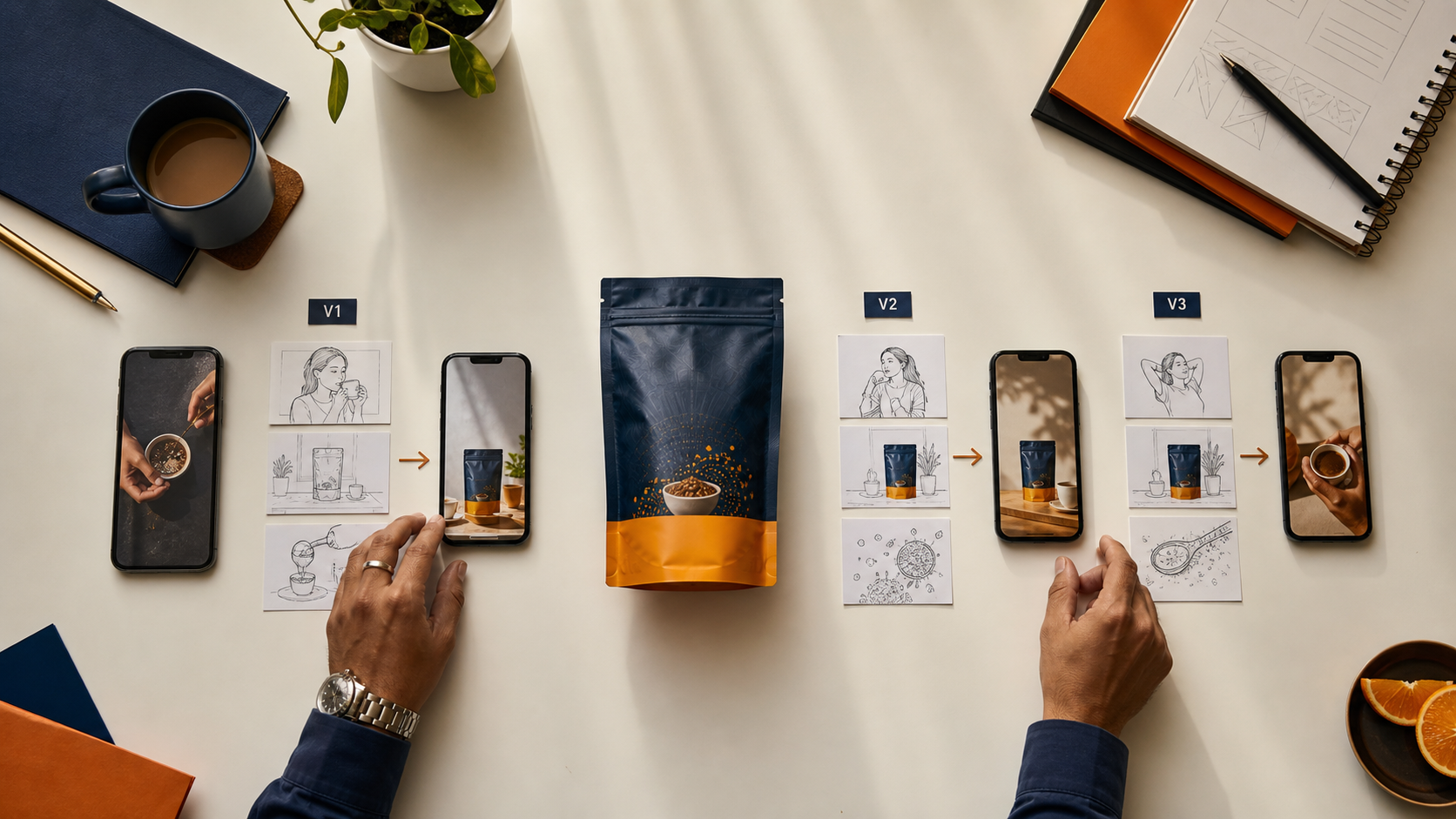
Creative iteration is the evidence-led process of improving an existing ad through controlled versions. Each version keeps the useful parts of the baseline and changes one declared constraint, such as the first frame, hook, proof moment, product demonstration, offer hierarchy, or CTA. It is different from ideation: ideation starts a new concept, while iteration learns from something already launched or reviewed.
Baseline: the approved or launched ad that gives the team a reference point.
Signal: the clearest observed problem, not a vague opinion that the ad feels tired.
Locked elements: the product truth, buyer, promise, offer, and any element still doing its job.
Variable: the one meaningful element changed in the next batch.
Decision rule: what result would make the team keep, revise, or stop that direction.
What is the fastest creative iteration process?
Use a five-step loop: diagnose, lock, change, review, learn. First name the weakest point in the viewer journey. Then lock everything that is not part of that diagnosis, create three to five versions of one variable, review them against the real SKU and approved message, and record one next decision. This avoids the expensive habit of replacing a whole ad when only its opening or proof is weak.
1. Diagnose one constraint from attention, comprehension, belief, action, or continuity.
2. Write a test card listing what stays fixed and what may change.
3. Produce one baseline plus three to five controlled versions.
4. Reject product drift, claim drift, unreadable crops, and accidental extra variables.
5. Promote the useful element into the next batch and archive the learning.
Build the baseline with /blog/ad-creative-brief-template-india, then create drafts in /dashboard/ugc-video.
Use /blog/ad-creative-workflow-d2c-india to assign owners, review gates, and handoffs around each batch.
Which part of a D2C ad should you iterate first?
Iterate the earliest broken step in the buyer journey. A stronger CTA cannot rescue an opening nobody notices, and a new hook cannot fix a landing page that contradicts the offer. Use directional platform signals alongside comments, sales calls, customer questions, and a frame-by-frame creative review. Treat performance as a clue, not automatic proof of why an ad won or lost.
People do not stop: change the first visual, first spoken line, or first on-screen idea.
People watch but remain confused: simplify the product action and remove competing messages.
People understand but do not believe: strengthen visible demonstration, comparison, or approved evidence.
People click but do not buy: check product-page continuity, price, offer, delivery promise, and checkout friction.
A proven ad is tiring: preserve its commercial argument and refresh delivery, crop, scene, or opening.
Use /blog/ad-creative-fatigue-d2c-india to confirm the pattern and choose the smallest effective refresh.
How do you build an iteration ladder instead of random variants?
An iteration ladder changes variables in a deliberate order. Start near the top of the viewer journey and move deeper only after the previous step is clear: attention, understanding, belief, action, then format expansion. A winning hook can move into new proof versions; a winning proof can move into static cards or regional-language adaptations. Every rung inherits one verified element from the rung below it.
Rung 1 — Attention: three openings around the same buyer hesitation.
Rung 2 — Understanding: one winning opening with simpler demonstrations or scripts.
Rung 3 — Belief: keep the explanation and compare proof styles.
Rung 4 — Action: keep the argument and clarify the approved offer or CTA.
Rung 5 — Expansion: adapt the proven argument into static, creator, scene, or language formats.
Choose a buyer argument with /blog/d2c-ad-creative-angles-india and audit the baseline with /blog/ad-creative-audit-checklist-india.
How can AI UGC speed up creative iteration safely?
AI UGC can make controlled visual drafts faster when the product reference, message, and variable are explicit. Use one approved base prompt with a locked block for creator, SKU, setting, action, claim boundary, offer, CTA, crop, and duration. Duplicate it and change only the variable block. Human review must reject invented product details, testimonials, prices, results, endorsements, or usage behaviour.
Generate three hook deliveries without changing the product demonstration.
Compare direct-to-camera, demo-first, and voiceover structures around the same approved proof.
Keep readable claims, prices, subtitles, and disclaimers in controlled post-production.
Use real creators when personal experience, authentic handling, whitelisting, or testimonial rights matter.
Follow /blog/ugc-video-generator-ad-variations-india for prompt locks and batch QA.
Why does creative iteration fail?
Creative iteration fails when a team changes too much, reads noisy results as certainty, or keeps producing without a stopping rule. The most common failure is cosmetic iteration: swapping colours, captions, or creators while leaving a weak buyer argument untouched. Another is false control, where the hook is labelled as the variable but the scene, pace, proof, and offer also change.
Do not call five unrelated concepts an iteration batch.
Do not declare causation from one small or uneven delivery result.
Do not preserve a weak promise merely because the video looks polished.
Do not generate more variants when the real break is offer or landing-page continuity.
Do not present synthetic people as real customers or invent their product experience.
Source note: Google's video creative guidance groups effective work around attention, branding, connection, and direction, support.google.com/google-ads/answer/14783551.