Testimonial Ad Playbook

UGC AdsBy Indian UGC Team10 min read

Testimonial Ads for Indian D2C Brands

A testimonial ad turns a specific customer problem, product experience, and believable proof cue into a short ad. The fastest safe workflow is to choose one buyer hesitation, write a hook-proof-CTA script, film a real customer or creator with documented permission, and use AI UGC only for clearly fictional concept testing—not fabricated customer endorsements.

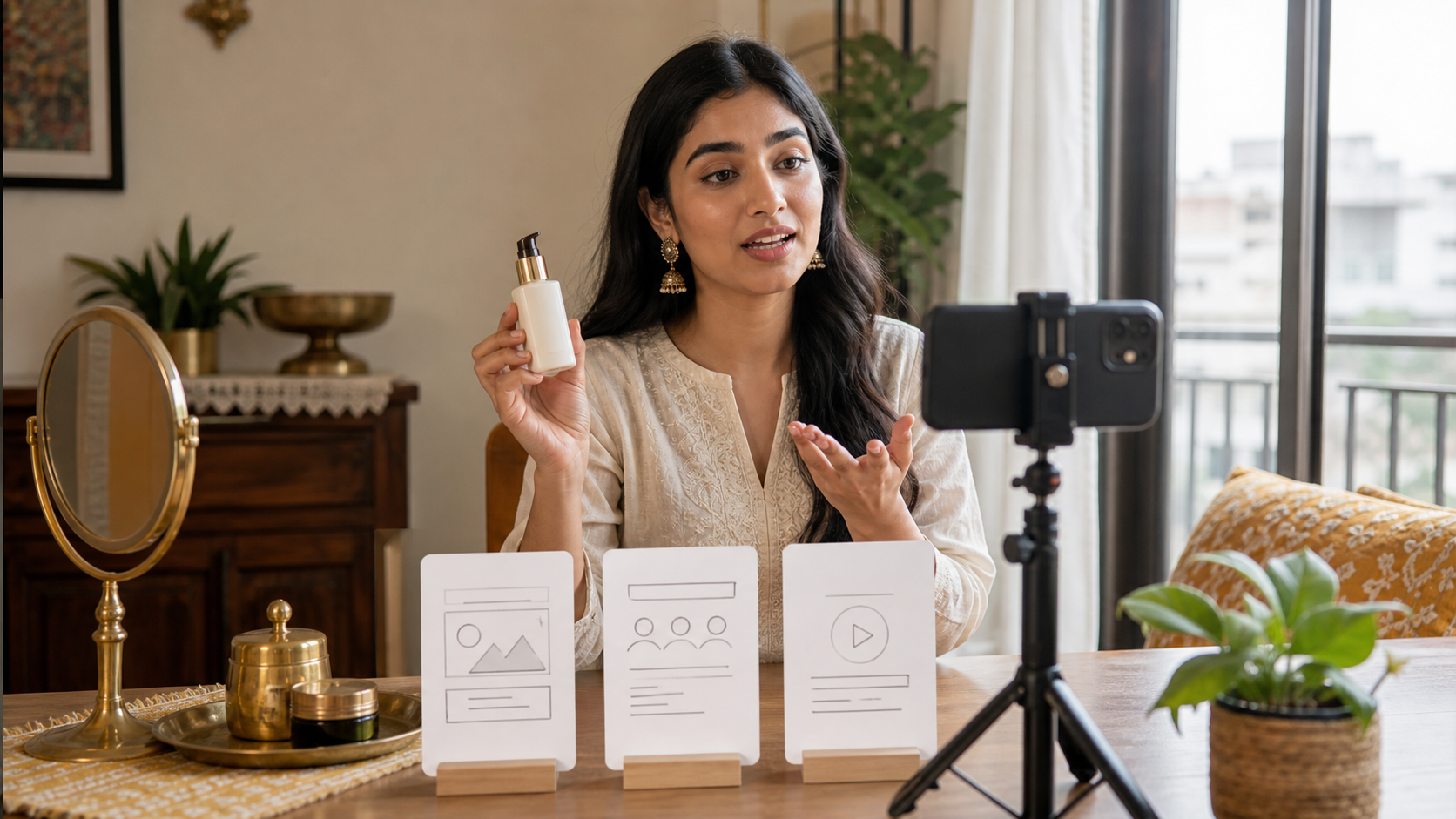
Indian creator filming a product testimonial ad with hook, proof, and call-to-action storyboard cards

What is a testimonial ad?

A testimonial ad is an advertisement built around a person's stated experience with a product or service. Strong testimonial advertising names the original problem, shows a believable product-use moment, and explains a specific outcome without turning the story into an exaggerated guarantee. For paid media, the speaker's relationship to the brand and permission to use the asset should be clear.

Use /blog/ugc-ads-examples-india to compare testimonial structures with demos, routines, and objection-led ads.

Use /blog/ugc-usage-rights-india before using a customer's or creator's face, voice, quote, or footage in paid ads.

Use /blog/ugc-creator-contract-india when a creator is producing the testimonial-style asset for your brand.

Draft a concept in /dashboard/ugc-video before spending on a full creator shoot.

Which testimonial ad should you make first?

Start with the buyer hesitation closest to purchase. If shoppers doubt ease of use, show a first-use walkthrough. If they doubt fit, taste, texture, or routine compatibility, show that exact moment. If they doubt value, explain frequency of use or what the product replaced. One narrow, credible experience is stronger than a list of universal claims.

Beauty: texture, application, routine fit, and a restrained personal observation.

Food and beverage: serving moment, taste description, convenience, and repeat-use context.

Fashion: fit, fabric feel, sizing context, and where the customer wore it.

Home goods: the old irritation, one product action, and the practical after-state.

Avoid invented reviews, guaranteed outcomes, unverified numbers, and regulated claims.

How do you write a testimonial video script?

Use a four-part script: buyer problem, discovery, product proof, and next step. Keep the spoken copy conversational and let the visual prove at least one line. A 15-second draft usually needs one hook, one product action, one observation, and one CTA—not the brand story, five benefits, and a discount read in the same clip.

Hook: “I kept buying travel bottles that leaked inside my bag.”

Discovery: “I tried this one before my last work trip.”

Proof: “The locking cap stayed shut, and I could open it with one hand.”

CTA: “If leaking is your problem too, check the size that fits your routine.”

Use /blog/ugc-script-template-india for reusable 15-, 30-, and 45-second script structures.

Use /blog/ugc-hooks-examples-india when the story is credible but the opening line is weak.

When can AI UGC support testimonial advertising?

AI UGC can safely support concept development, internal storyboards, hook testing, language drafts, and fictional creator-style demonstrations that do not claim to be real customer experiences. It should not manufacture a named customer's review, copy a real person's likeness or voice, or present invented results as evidence. Label and review synthetic assets according to the platforms and markets where they run.

Safe first use: test three hooks before commissioning a real creator or customer shoot.

Safe variant: translate the creative concept into natural Hinglish or a regional language, then review it with a fluent speaker.

Unsafe use: invent a five-star customer, medical result, income result, or before-and-after story.

Source note: ASCI's Guidelines for Influencer Advertising in Digital Media explain disclosure expectations for material connections, asci.social/guidelines.

Source note: Meta documents disclosure tools and labels for certain AI-generated content, transparency.meta.com/features/explaining-ranking/ai-disclosure.

Use /blog/ai-ugc-ad-compliance-checklist-india for a broader pre-launch claims and disclosure review.

Why do testimonial ads fail?

Most testimonial ads fail because they sound written by the brand. The speaker praises everything, gives no concrete product moment, and reaches the offer before earning belief. Other failures are equally costly: weak usage rights, claims that cannot be substantiated, a hidden material connection, or an AI-generated speaker framed as a real customer.

Too polished: replace slogans with the customer's actual problem vocabulary.

Too vague: show one product action and one observable detail.

Too broad: build separate ads for fit, convenience, value, taste, or routine.

Too risky: remove unsupported claims and confirm rights, disclosures, and platform rules.

Too slow: make the problem and product understandable in the opening seconds.

How should you test testimonial ads?

Hold the core proof story steady and change one variable at a time. Test the hook first, then the speaker or setting, then the CTA. Compare testimonial creative against a product demo or static proof card, because some buyers need to see use rather than hear praise. Judge the full path from thumb-stop to qualified conversion, not views alone.

Baseline: one customer problem, one product action, one CTA.

Variant A: problem-first hook.

Variant B: surprising product detail.

Variant C: objection-first opening.

Use /blog/ad-creative-testing-india to plan a controlled weekly test.

Use /dashboard/static-ads to turn the winning proof cue into a retargeting creative.

Testimonial ad decision table

Buyer doubt
Best proof story
Do not claim
Will it fit my routine?
Show when, where, and how the customer uses it
That it works for everyone
Is it easy to use?
Show first use and one practical detail
That it is completely effortless
Is it worth the price?
Explain repeat use, durability, or what it replaced
Guaranteed savings without evidence
Will I like the taste or feel?
Use specific sensory language and serving context
A universal preference
Can I trust the result?
Use substantiated evidence and a real experience
Invented outcomes or fake customers
Should we use AI first?
Create a fictional concept draft for internal testing
That an AI persona is a real buyer

Best For

Indian D2C brands with real customer stories and documented permission

Products where fit, taste, texture, setup, or routine needs explanation

Performance teams testing proof-led creative against product demos

Agencies drafting concepts before customer or creator production

Not Ideal For

Fabricated customer endorsements or invented ratings

Regulated claims without legal and substantiation review

Using a person's face, voice, quote, or footage without permission

AI personas presented as named real customers

Examples

Skincare: “I wanted something that sat under sunscreen without pilling.” Show the amount, texture, and morning layering moment.
Snack: “I needed a 4 pm option that was easy to keep at my desk.” Show the pack opening, serving size, and a specific taste note.
Fashion: “I was unsure about the fit around the shoulders.” Show the size worn, movement, and one styling context.
Home organizer: “This drawer wasted five minutes every morning.” Show the old friction, one setup action, and the practical reveal.
Travel product: “I bought it because my old bottle leaked.” Show the lock, bag placement, and one-handed use.
AI concept draft: a fictional creator demonstrates the product and speaks in first person about the use case, while the brand avoids calling it a real customer review.

FAQs

What is a testimonial ad?

A testimonial ad is an advertisement based on a person's stated experience with a product or service. Effective versions connect one customer problem to one believable product-use moment and a specific observation, with appropriate permission, disclosure, and claim review.

What is the best testimonial video script format?

Use four parts: the buyer's original problem, how they found the product, one visible or specific proof moment, and a relevant CTA. Keep the script conversational and avoid packing multiple benefits or unsupported outcomes into one video.

Can AI create testimonial ads?

AI can create fictional concept drafts, hooks, storyboards, translations, and creator-style demonstrations. Do not present an AI persona as a real customer, invent a customer review, imitate a real person without permission, or turn generated claims into evidence.

Do testimonial ads need disclosure in India?

A material connection between an advertiser and an influencer or creator may require clear disclosure. Review current ASCI guidance, platform rules, the specific relationship, and the final placement before publishing.

Why do testimonial ads sound fake?

They sound fake when every line is praise, the speaker uses brand slogans, and no concrete product moment appears. Use the customer's problem vocabulary, show one observable detail, and remove claims the speaker cannot credibly support.

Should I test a testimonial ad or a product demo first?

Use a testimonial ad when the buyer needs relatable experience or objection handling. Use a product demo when the buyer mainly needs to understand how the product works. Test both when possible, keeping the offer and audience consistent.

Can AI UGC replace real creators?

AI UGC is best for fast creative testing, early campaign drafts, hook exploration, and low-cost content volume. Real creators still matter for influencer distribution, creator trust, and testimonial rights.

Does AI UGC work for Indian audiences?

It can work well when the prompt includes Indian personas, local language, realistic home settings, product-in-hand moments, and duration-safe dialogue instead of generic global stock-style scenes.

What assets do I need to start?

A product name, a short product brief, and ideally one clean product image are enough to generate the first AI UGC video or product visual.